REVIEW · HISTORICAL TOURS
PRIVATE Beirut Historical Walking Half Day Tour
Beirut tells its story in layers. This private half-day tour brings those layers together, from the National Museum to war-scarred downtown and the sea at Raouche. I like the clear historical framing from guide David, also called Dave L., and the useful mix of driving and walking. You get a broad first look without wrestling with Beirut traffic or finding each site alone.
I also like the personal angle. David grew up in Beirut and explains the city’s civil-war years, political shifts, and daily life with the benefit of lived experience. The main drawback is pace: the tour covers a lot in three to four hours, so some stops are brief and the Beirut Souks are more of a quick look than a serious shopping session.
In This Review
- Key points at a glance
- Why this short Beirut tour works
- The National Museum makes sense of Beirut’s past
- Downtown Beirut reveals the cost of rebuilding
- Place des Martyrs and the city’s religious center
- The Beirut Souks show a polished, modern center
- Raouche and Pigeon Rocks provide the classic Beirut view
- David’s guiding style is a major part of the value
- Transport and timing make this useful for a short stay
- Is the $93.34 price fair?
- Who will get the most from this experience?
- Practical details before you book
- Should you book the Beirut Historical Walking Half Day Tour?
- FAQ
- How long does the private Beirut historical tour last?
- What time does the tour start?
- Is hotel pickup available?
- Is this a private tour?
- What transportation is used?
- Does the tour visit the National Museum of Beirut?
- Which downtown sights are included?
- Are Pigeon Rocks and the Corniche included?
- Is lunch included?
Key points at a glance
- A strong first stop: The National Museum gives you the historical framework needed to understand the city’s many eras.
- Personal local context: David’s explanations and firsthand memories add meaning to places that can otherwise feel hard to read.
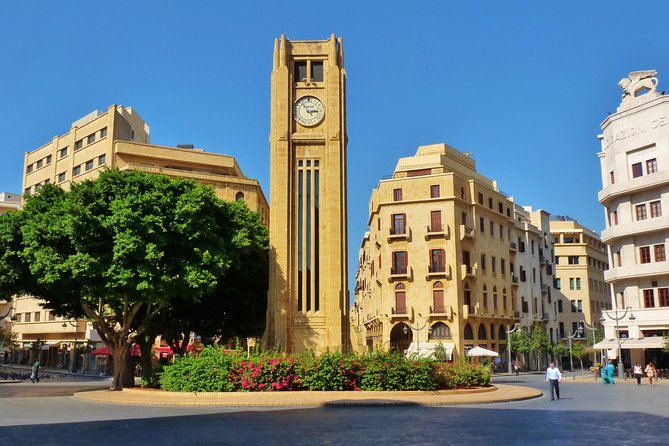
- Downtown in one walk: See Place des Martyrs, Mohammad Al-Amin Mosque, St. George’s Cathedral, the Roman baths, Star Square, and the restored souks.
- Easy transport: Air-conditioned pickup and drop-off within Beirut keep the day simple, especially for a short visit.
- Two classic views: Pigeon Rocks and the Corniche finish the outing with Beirut’s most recognizable coastal scenery.
- Private format: Only your own group participates, making it easier to ask questions or adjust the flow.
Why this short Beirut tour works
Beirut is not a city you understand from a checklist alone. Its center contains Roman remains, Ottoman-era traces, grand religious buildings, postwar reconstruction, modern commerce, and visible reminders of conflict. The city has been destroyed and rebuilt repeatedly, with the civil war from 1975 to 1990 shaping much of what you see today.
That makes a local guide especially useful. A monument may look polished, damaged, relocated, or oddly separated from its surroundings. David’s role is to connect those pieces. He begins with an orientation to Beirut, using a map and an audio presentation to explain the city and Lebanon’s political past before the sightseeing starts.
I appreciate that order. You are not simply dropped beside a stone building and handed a date. You get a basic map in your head first, then begin seeing how the different districts and communities fit together.
The private format helps, too. You are not trying to hear a guide over a large crowd, and you can ask about subjects that interest you. If the history of Lebanon is your main reason for booking, the conversation is likely to be as valuable as the monuments.
More history tours in Beirut:
- Historical Beirut Tour (AM) Half Day – (4G on Board)
★ 4.0 · 16 reviews - Temple of Eshmun – Mleeta Landmark – Beaufort Castle
★ 5.0 · 9 reviews - Sidon & Tyre Unesco Heritage w/pick-up, guide, entries+lunch
★ 4.9 · 6 reviews
The National Museum makes sense of Beirut’s past
The tour drives first to the National Museum of Beirut, located on the eastern side of the city. Built in the 1940s, the museum was badly affected during the civil war and revived in the 1990s. That story alone makes the visit relevant to this tour: the building is not just a container for antiquities, but part of Beirut’s modern experience.
Inside, you can expect the guide to use the collection as a way into Lebanon’s long past. The museum helps place Beirut within the wider story of the country, rather than treating the capital as an isolated modern city.
One useful feature is the introductory audio presentation, which explains some of the complexities of Beirut and Lebanon. Combined with the guide’s opening briefing, it gives you a better foundation before you begin walking around downtown.
Allow yourself to listen carefully here. The museum is the most content-heavy part of the outing, and the downtown walk makes more sense after it. If you are especially interested in archaeology and ancient history, this may feel like the highlight. If you prefer street life and architecture, you may find the later walk more memorable.
The published stop timing gives the museum and central Beirut a substantial portion of the morning, but the complete experience lasts about three to four hours. That means the exact amount of time inside can vary. Keep your expectations realistic: this is an introduction, not a slow museum study day.
Downtown Beirut reveals the cost of rebuilding
After the museum, the tour moves into Solidere and central Beirut. This area was heavily damaged during the civil war and restored during the 1990s. The result is a downtown that can feel unusually neat in places, yet remains closely tied to a difficult recent past.
That contrast is one of the most interesting parts of the experience. Rebuilt facades and broad streets may suggest a fresh start, but the guide’s explanation helps you see the decisions, losses, and political background behind the reconstruction.
The walk includes the parliament house, the government palace, Roman baths, Star Square, religious buildings, and other central sights. You will not need to work out how to connect these places yourself. David leads the route and explains why each site matters.
This is where his personal perspective becomes particularly useful. Several comments about the tour point to his ability to discuss the city’s past clearly, including his own memories of growing up in Beirut during difficult years. That kind of explanation can turn a restored district from a collection of attractive buildings into a place with real tension and human meaning.
Do not expect every downtown stop to receive the same amount of time. The route is broad by design. You get the main structure of Beirut’s center, with enough explanation to decide what deserves a longer return visit.
Place des Martyrs and the city’s religious center

Place des Martyrs is one of the key public spaces on the route. It leads naturally toward Mohammad Al-Amin Mosque, St. George Maronite Cathedral, the Roman baths, and Star Square.
The Mohammad Al-Amin Mosque is one of downtown Beirut’s most recognizable buildings. Its scale and appearance make it an important landmark, but the value of seeing it with a guide goes beyond taking a photograph. Its location beside Christian religious buildings makes the area a useful place to discuss Beirut’s mixture of communities and the city’s long political and religious tensions.
St. George Maronite Cathedral adds another side of that picture. Seeing the mosque and cathedral within the same central walk gives you a quick, visual lesson in Beirut’s religious diversity.
The Roman baths are a different kind of reminder. Ancient remains sit within a working capital, close to government buildings, places of worship, shops, and traffic. You can see how Beirut’s past is not confined to one archaeological park. It appears in fragments among modern city life.
Star Square rounds out the central walk. This section is compact enough to cover on foot, but wear comfortable shoes. The tour is called a walking tour for good reason, even though the vehicle handles the longer transfers.
More walking tours in Beirut:
- Beirut Full Day Walking Tour
★ 5.0 · 14 reviews - Beirut: Private Walking Tour With A Guide (Private tour)
★ 4.9 · 9 reviews - Beirut Walking Tour – Discover Beirut by foot
★ 5.0 · 2 reviews
The Beirut Souks show a polished, modern center
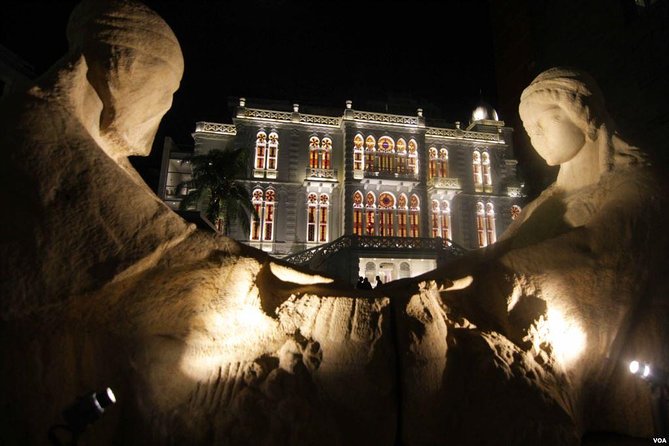
The Beirut Souks were completely demolished during Lebanon’s wars and later rebuilt as an open-air shopping mall in the central district. They are worth seeing because they show another response to the city’s destruction: commercial reconstruction rather than ancient preservation.
The souks may surprise you. The word suggests an old market, but this area is a modern retail complex. It gives you a sense of how central Beirut was reshaped after the war and how the restored district was intended to function.
I would treat this as an architectural and urban-planning stop more than a shopping excursion. The stated stop is about an hour, but the full tour has several major locations to cover. If you want to browse shops at length, eat, or shop for gifts, plan to return on your own.
The contrast between the souks and the Roman baths is useful. In a few minutes, you move from ancient remains to a modern commercial center, with the civil war and reconstruction linking the two.
Raouche and Pigeon Rocks provide the classic Beirut view
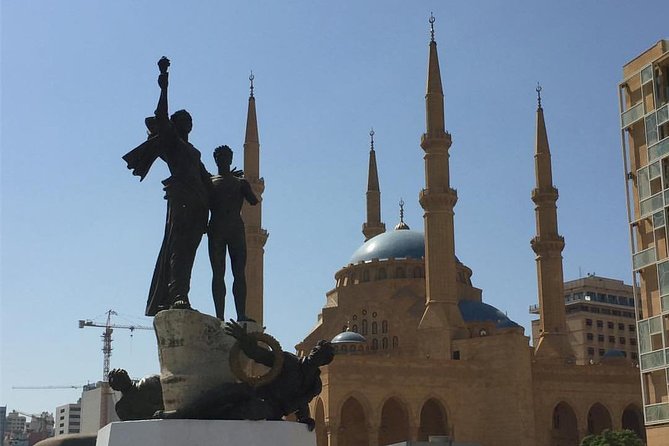
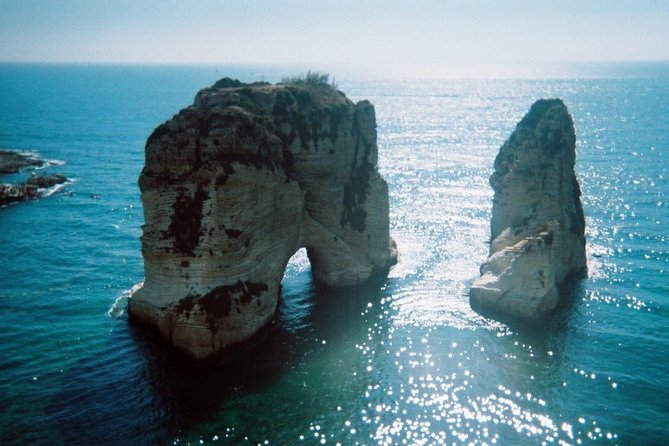
The drive to Raouche takes you away from the central monuments and toward the coast. Pigeon Rocks are often treated as the symbol of Beirut, and the short stop gives you the city’s most famous natural viewpoint.
The rocks rise from the sea beside the Corniche, creating a sharp change of mood after the museum and downtown history. Here, you can pause, take photographs, and simply look out over the water.
The stop is listed at about 15 minutes, so do not expect a long coastal walk. You will have time for the essential view, but not necessarily an unhurried exploration of the entire waterfront.
The Corniche adds another brief coastal stop, with the possibility of seeing the sunset depending on the day and timing. Since the tour begins at 9:00 a.m., the sunset reference appears to describe the scenery rather than a guaranteed sunset visit. You should not book this outing solely for evening light.
Still, the Corniche is a fitting finish. Beirut’s story is easier to absorb after you have seen the city from the water’s edge. The coast gives you a sense of the capital’s setting, while Pigeon Rocks supplies the memorable final image.
David’s guiding style is a major part of the value
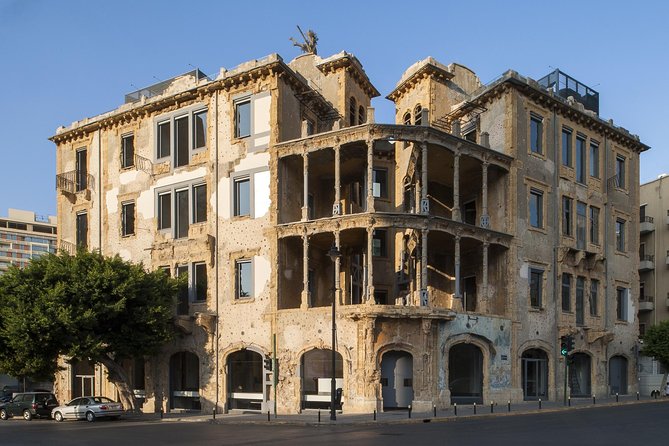
The strongest thread running through this experience is the guide. David is described as professional, polite, reliable, flexible, and easy to engage with. His explanations cover Beirut from ancient periods through the civil war and into more recent events.
That range matters because Lebanese history can become confusing quickly. Dates, political groups, religious communities, foreign involvement, and changing city districts all overlap. A guide who can explain the connections without turning the walk into a lecture makes a real difference.
The feedback also points to David’s use of a map, an audio introduction, and open discussion. Those tools are simple, but they help organize a complicated subject. You can ask questions as the day develops instead of trying to remember a stream of disconnected facts.
His firsthand memories are another advantage, though they also shape the tone of the tour. If you want a strictly academic presentation, this may feel more personal than formal. I see that as a strength for most people, provided you understand that this is a guided interpretation rather than a university seminar.
The private setting gives the guide more room to respond to your interests. A couple interested in recent political history can ask more about that subject. A first-time visitor with only a few hours can keep the focus on major sights.
Transport and timing make this useful for a short stay
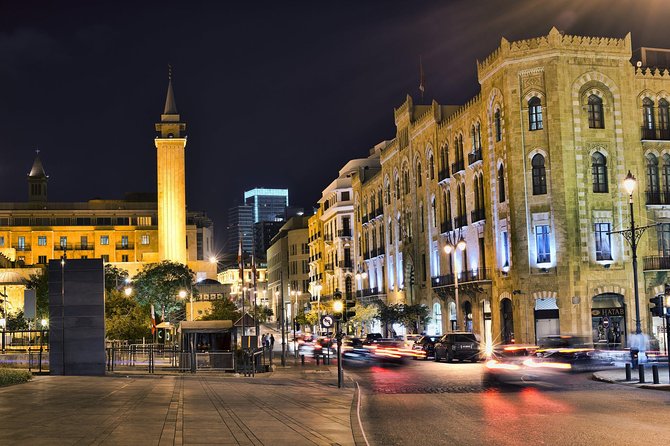
Pickup and drop-off are offered within Beirut, and the tour uses an air-conditioned vehicle. That is a meaningful convenience in a city where crossing from one area to another can take time and where a short visit rewards efficient planning.
The vehicle is used for the museum transfer and the drive to Raouche, while the downtown section is done on foot. This combination is better than an all-driving city tour because you get close to the central places and have time to look around.
The advertised start time is 9:00 a.m., and the experience lasts roughly three to four hours. That makes it easy to place on the first morning of a Beirut stay, before a later meal or another activity. It also suits someone with only four or five hours available, a point specifically highlighted by one participant who found the duration just right.
The stop durations can look longer when added together than the stated tour length. Think of them as approximate planning notes, not fixed appointments. Traffic, questions, museum time, and the walking pace of your group can affect the sequence.
A minimum number of participants is required for the activity to operate, despite the tour being private once confirmed. Most people can participate, according to the booking information, but no detailed accessibility information is provided. If mobility is a concern, ask the operator about the walking sections before booking.
Is the $93.34 price fair?
At $93.34 per person, the cost is not the cheapest way to look at Beirut. It becomes more reasonable when you count what is included: private participation, a driver-guide, air-conditioned transport, Beirut hotel pickup and drop-off, museum admission, and other listed fees and taxes.
You are paying for structure as much as transport. Without a guide, you could visit some downtown sights and Pigeon Rocks yourself, but you would have to arrange the sequence, manage the transfers, and make sense of the city’s recent past on your own.
The value improves if you are short on time or traveling as a small private group. Group discounts are offered, though the actual reduced price is not stated, so check the total before you commit.
Lunch is not included. That is not a serious problem for a half-day outing, but you should plan your meal separately. The tour ends after the coastal stops, so you can ask the operator about the expected return time if you have a tight afternoon schedule.
I would call the price fair for someone who wants context, convenience, and a private guide. It is less compelling if you enjoy arranging your own walks, already know Beirut well, or mainly want a relaxed morning by the sea.
Who will get the most from this experience?
I would choose this tour if you are visiting Beirut for the first time and want a firm orientation in one morning. It works especially well for people who care about history, architecture, religious diversity, and the way a city rebuilds after conflict.
It also suits couples and families who prefer a private setting. You can ask questions freely, adjust the discussion, and avoid being tied to the interests of a large group.
This may not be the best choice if you want extended museum time, a food-focused outing, or a long shopping session at the souks. The experience covers many places, so its strength is range and explanation rather than lingering at one site.
I would also avoid making it your only Beirut experience if you have several days in the city. It is a strong introduction, but the short format leaves plenty for a later return, especially the museum, central streets, and waterfront.
Practical details before you book
The tour begins at 9:00 a.m. and offers pickup and drop-off from Beirut city. Confirmation is normally received at booking, but bookings made within 12 hours of departure are confirmed as soon as possible, subject to availability.
Free cancellation is available up to 24 hours before the start time for a full refund. Changes or cancellations inside that 24-hour period are not accepted for a refund.
Bring comfortable footwear for the downtown walk and allow room in your schedule for traffic and discussion. Since lunch is not included, plan to eat before or after the experience.
The advertised rating is 5 out of 5 from 27 ratings, with 100 percent recommending the tour. The most consistent praise centers on David’s clear explanations, personal connection to Beirut, good organization, and ability to make a complicated past understandable without making the tour dull.
Should you book the Beirut Historical Walking Half Day Tour?
Book it if you want Beirut explained, not merely photographed. The National Museum, restored downtown, Roman baths, religious landmarks, Beirut Souks, Pigeon Rocks, and the Corniche give you a useful cross-section of the city, while David’s personal guidance supplies the connections between them.
I would recommend it most strongly for a first visit, a short stay, or anyone interested in Lebanon’s political and social past. Skip it if you prefer slow independent wandering or want a full day devoted to one museum or neighborhood.
For many people, this is a sensible first morning in Beirut: efficient, personal, and honest about a city that has been repeatedly damaged, rebuilt, and reshaped.
FAQ
How long does the private Beirut historical tour last?
The experience lasts approximately three to four hours.
What time does the tour start?
The stated start time is 9:00 a.m.
Is hotel pickup available?
Yes. Pickup and drop-off are offered from locations within Beirut city.
Is this a private tour?
Yes. Only your own group participates in the activity.
What transportation is used?
The tour includes an air-conditioned vehicle, with a driver-guide handling the transfers.
Does the tour visit the National Museum of Beirut?
Yes. The National Museum is the first main stop, and admission is included.
Which downtown sights are included?
The downtown route includes Place des Martyrs, Mohammad Al-Amin Mosque, St. George Maronite Cathedral, the Roman baths, Star Square, the Beirut Souks, and other central landmarks.
Are Pigeon Rocks and the Corniche included?
Yes. The tour drives to Raouche for Pigeon Rocks and also includes a stop at the Beirut Corniche.
Is lunch included?
No. Lunch is not included in the tour price.
Just added in Beirut
- Wine Tasting Tour★ 5.0 · 2 reviews
- Lebanon tours vip jeitta byblos beirut we charge per vechile not per person.★ 5.0 · 1 review
- Lebanon’s Treasures: Jeita Grotto and Harissa Private Tour★ 5.0 · 2 reviews
- Journey Through Time: A Private Tour of Tripoli and Byblos★ 5.0 · 1 review
- Small Group Tour to Baalbek, Anjar & Ksara with Hotel pickup★ 5.0 · 2 reviews
- Small-Group Tour with Lunch to Sidon, Tyre & Maghdouche★ 5.0 · 2 reviews
- Guided Small-Group Tour to Baalbek, Cedars & Qozhaya with Lunch★ 5.0 · 2 reviews
- Small-Group Tour Qadisha Valley, Becharre and Cedars with Lunch and Tickets★ 5.0 · 1 review
Historical Tours
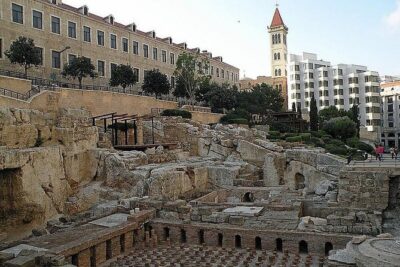
Historical Beirut Tour (AM) Half Day – (4G on Board)
Read our review →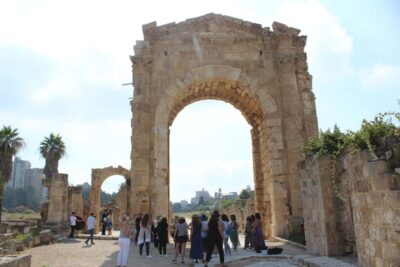
Sidon & Tyre Unesco Heritage w/pick-up, guide, entries+lunch
Read our review →
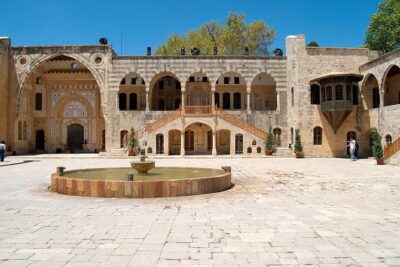
PRIVATE tour to Beirut history museum, Beiteddine & Deir elQamar
Read our review →
Baalbek, Anjar & Wine: A Journey Through Lebanon’s Heritage
Read our review →
Exploring Beirut’s Past: A Private Guided Historical Tour
Read our review →