REVIEW · BYBLOS TOURS
Journey Through Time: A Private Tour of Tripoli and Byblos
Ancient cities, one busy day. This private trip links Tripoli’s medieval souks and mosques with Byblos, Lebanon’s famous old port, so you get two very different views of the country without arranging transport yourself. I especially like the hotel pickup and private vehicle, and the chance to see working markets, old baths, craft shops, and historic waterfronts rather than only major monuments. The main drawback is pace: with roughly 15 stops packed into six hours, some visits will feel like quick looks instead of long explorations.
The price is $50 per person, which is strong value if two or more people share the vehicle and want a full day beyond Beirut. You should also plan for entrance fees at the Citadel of Tripoli and Byblos Castle, plus lunch and a tip. Hassan receives warm praise for being friendly and well informed, although the tour information only promises an English-speaking driver, so your exact guiding experience may depend on who is assigned.
In This Review
- Key points at a glance
- Why this Beirut day trip works
- Tripoli’s old quarters and layered past
- The Citadel of Saint Gilles in 30 minutes
- Al Mansouri and Taynal Mosques
- Tripoli’s souks, khans, and old bathhouses
- Hallab sweets and Al-Mina port
- Byblos, from ancient port to old souk
- Byblos Castle and the ancient harbor
- What the private format is worth
- Who should book this tour?
- Should you book Journey Through Time?
- FAQ
- What is included in the Tripoli and Byblos tour?
- How long does the tour last?
- Are entrance fees included?
- Is lunch included?
- Is this a private tour?
- Can I cancel for a full refund?
Key points at a glance
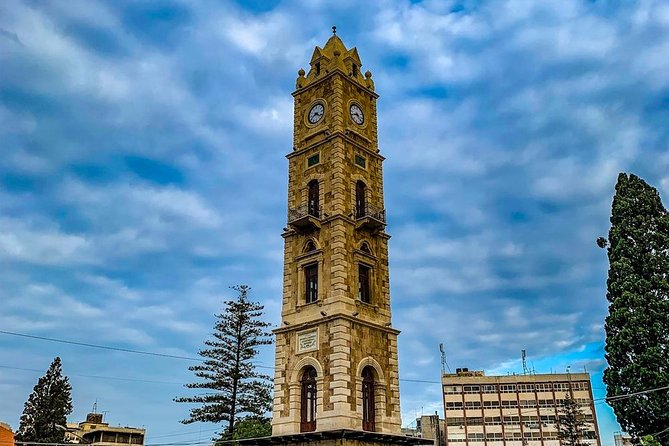
- Tripoli gives you working city life: Its souks still serve tailors, soap makers, sweet shops, and other local trades.
- The Citadel of Tripoli layers several eras: Fatimid, Crusader, Mamluke, and Ottoman work can all be seen in one fortress.
- Byblos offers a calmer coastal finish: The castle, old port, and market sit close together, making the second half easy to explore on foot.
- Private transport makes the distance worthwhile: Hotel pickup and drop-off remove the need to organize a long northern outing from Beirut.
- The day is packed rather than leisurely: Most Tripoli stops last only five to 15 minutes, while the castle visits receive more time.
- Budget for two paid entries: Admission is not included at the Citadel of Saint Gilles or Byblos Castle.
Why this Beirut day trip works
Lebanon’s capital is a useful base, but Tripoli and Byblos show you a different side of the country. Tripoli is a living urban center with medieval religious buildings, covered markets, old bathhouses, and working commercial quarters. Byblos is more compact and polished, with archaeological remains, a Crusader castle, an old harbor, and an attractive market area.
I like the basic design of this outing because it joins two places that are easy to confuse on a map but very different in feel. Tripoli rewards attention to street life and architecture. Byblos brings the day back toward the sea, with a more compact old town and time to look around the port.
The tour begins at 9:00 a.m. and lasts about six hours. That includes driving between Beirut, Tripoli, and Byblos, so you should not expect a slow archaeological study. Instead, think of it as a well-filled introduction. You get the broad picture, several memorable sites, and enough context to decide where you would like to return.
More of Byblos:
- Guided Small-Group Tour to Jeita, Harissa, Byblos with Lunch
★ 5.0 · 361 reviews - Jeita Grotto,Harissa&Byblos Full-Day PRIVATE-CAR Trip from Beirut
★ 5.0 · 222 reviews - Jeita Grotto – Harissa – Byblos Trip
★ 5.0 · 169 reviews
Tripoli’s old quarters and layered past
Tripoli lies about 80 kilometers north-northeast of Beirut, on the Mediterranean coast near the Abu Ali River. It is among Lebanon’s oldest cities, alongside Byblos, Tyre, and Sidon, with roots reaching back to the Phoenician era.
The city has dozens of registered historic buildings, including 12 surviving mosques from the Mamluke and Ottoman periods. Its older center is especially rewarding because religious buildings, trade spaces, bathhouses, and caravan inns sit close together. You are not simply moving from one isolated sight to another. The streets themselves explain how the city worked.
The first stop gives you a short orientation to Tripoli. At 30 minutes, it is enough to establish the city’s character, but not enough for a full walk through every quarter. Keep your expectations realistic. The value here comes from seeing the city as a functioning place, not from checking off one grand monument.
The Citadel of Saint Gilles in 30 minutes
The Citadel of Tripoli, also called Qal’at Sinjil or Saint Gilles, rises above the city and provides the clearest wide view of Tripoli. Its size is impressive: the fortress measures about 140 meters long and 70 meters wide.
The site is a lesson in reused architecture. A Fatimid octagonal structure was later converted into a church by the Crusaders. Crusader work from the 12th and 13th centuries appears alongside Mamluke additions from the 14th century and Ottoman changes from the 16th century. Much of the fortress you see today also reflects restoration directed by Mustafa Barbar Agha, Tripoli’s governor in the early 19th century.
You receive 30 minutes here, which should allow time to walk through key areas and take in the city below. The paid admission is not included, so confirm the current entrance charge before setting out. For me, this is one of the day’s most important stops, and I would use the limited time for the views and the main architectural details rather than trying to inspect every corner.
Al Mansouri and Taynal Mosques
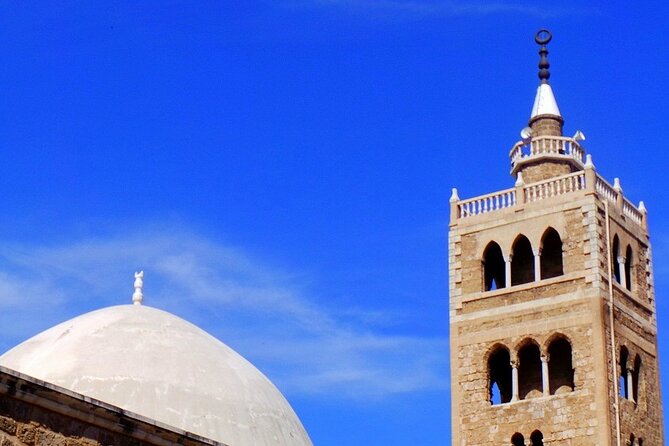
Al Mansouri Great Mosque dates from 1294 to 1315 and was built over the remains of the 12th-century Crusader cathedral of Saint Mary of the Tower. Its courtyard leads to a vaulted prayer hall, where traces of the earlier Western structure remain.
Look for the old northern entrance and the Lombard-style bell tower, which was adapted into the mosque’s minaret. Foundation plaques and written decrees also offer clues about construction and everyday life during the Mamluke period. The scheduled visit lasts 15 minutes, so this is a stop for a focused look, not a long architectural lecture.
Taynal Mosque dates from 1336 and was built on the site of a ruined Crusader church. Its founder, Saif Ed-Dine Taynâl, is buried in the adjoining domed mausoleum. The mosque reuses older material, including two rows of granite columns with late Roman capitals.
The entrance to the second prayer hall is especially notable for its Mamluke decoration. Again, you have only 15 minutes. If you enjoy architectural details, ask your driver or guide to point out the reused columns and the two prayer halls early in the visit.
More of Tripoli and Batroun:
- Aaqoura Lakes – Baatara Waterfall – Batroun
★ 4.5 · 55 reviews - PRIVATE city Tour of authentic Tripoli and vibrant Batroun
★ 5.0 · 51 reviews - Guided Small-Group Tour to Tripoli and Batroun with Lunch
★ 5.0 · 16 reviews - Tripoli City Lebanon Trip
★ 5.0 · 7 reviews
Tripoli’s souks, khans, and old bathhouses
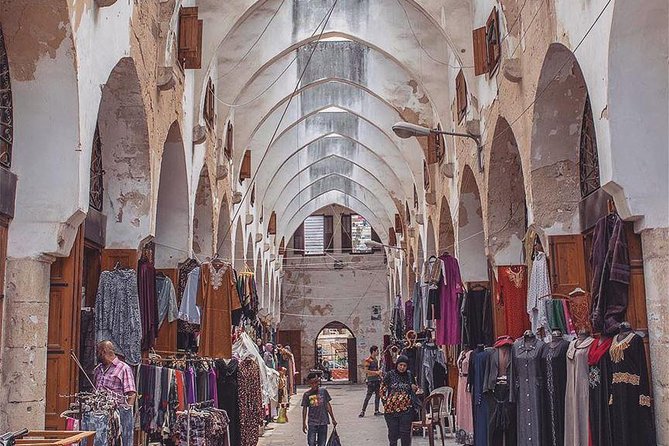
The souks are where Tripoli becomes most immediate. Nine named markets cover different trades, including Attareen, Bazerkan, Haddadin, Haraj, Kameh, Koundarjiyeh, Nahhasin, Samak, and Sayyaghin. There is also a food market with produce, meat, fish, and other daily goods.
The planned visit to Souk Al-Harajb lasts 15 minutes, but the market may be the part of Tripoli you remember best. You move through narrow passages, small alleys, shops, smells, sounds, and changing colors. This is a working commercial district, so you may find the pace less controlled than at a formal monument. Stay near your guide or driver and keep the short schedule in mind.
Khan Al-Khayyatin is a long rectangular caravan building with a covered central courtyard and shops along its sides. Its name points to its traditional trade: tailoring and related goods such as needles, thread, and sewing machines. The visit is listed at five minutes, so treat it as a quick architectural glimpse.
The Soap Khan, also called Khan As Sabon, dates from the early 17th century. It was first built as a military barracks for Ottoman troops and placed in the city center so the pasha could control possible unrest. Its two-story arcades run around a courtyard with a fountain. Five minutes will not allow a detailed visit, but the building helps explain how trade, government, and military power once shared the same urban core.
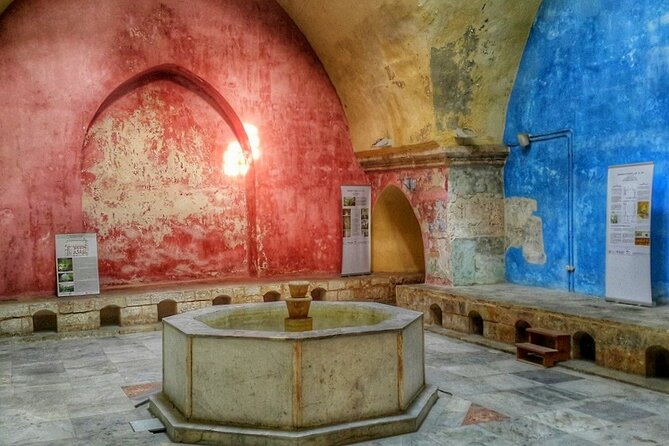
Tripoli’s bathhouses add another layer. Hammam Al-Jadid was built around 1740 and is the city’s largest hammam. It has not operated since the 1970s, yet its worn grandeur still suggests the role public bathing once played.
Ezzeddine Hammam is older, connected to the Mamluke governor Izz ed-Dine Aybak, who died in 1298 and is buried in a nearby mausoleum. The bathhouse was used until recently and is now under restoration. Each hammam receives only five minutes, so do not expect full interior access or a long explanation. Their importance lies in seeing how much of Tripoli’s civic life was organized around public facilities.
Hallab sweets and Al-Mina port
A stop at Hallab 1881 gives the schedule a welcome food angle. The Tripoli sweet maker began in 1881, and Kasr El Helou is now one of the city’s best-known landmarks. The visit lasts 15 minutes, enough to see the shop and consider buying a local sweet for later.
Lunch is not included, so this stop should not be mistaken for a provided meal. It may be a useful place to pick up something, but the tour does not specify a tasting or lunch arrangement. Ask about the day’s food timing early, especially since the schedule moves quickly.
The final Tripoli stop is El Mina, the coastal town and harbor area associated with modern Tripoli. It occupies the site of the old Phoenician city of Tripoli and includes nine islands. Four have been declared natural reserves to support fish breeding and protect their natural habitat.
The 15-minute port visit gives you a change of scenery after the dense old center. It is a short look at Tripoli’s connection to the Mediterranean before the route continues south to Byblos.
Byblos, from ancient port to old souk
Byblos is often presented as one of the world’s oldest continuously inhabited cities, with archaeological remains reaching back more than 7,000 years. It is also linked with the development of the Phoenician alphabet, a detail that gives the site importance far beyond its attractive waterfront.
You have one hour for Byblos before visiting the old souk, castle, and port separately. That hour is useful for getting your bearings around the historic center. Byblos feels more compact than Tripoli, and its mix of archaeological remains, stone lanes, cafes, and artisan shops makes it easy to shift between ancient sites and modern life.
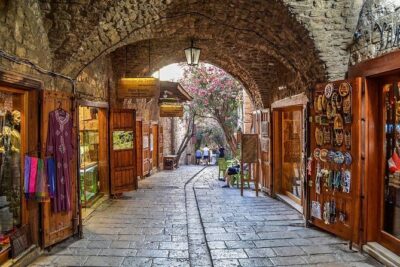
The Old Souk receives 30 minutes. Its narrow lanes run within the old city walls, with market stalls selling handicrafts, jewelry, textiles, and souvenirs. The stone archways and colorful wooden shutters make this a good place for photos, but the market is also a chance to look at local goods rather than simply pass through a monument.
I would save room in your bag and avoid rushing the first shop. Thirty minutes is enough for a walk and perhaps a purchase, but not for a long meal, extended bargaining, and a full exploration of every lane.
Byblos Castle and the ancient harbor
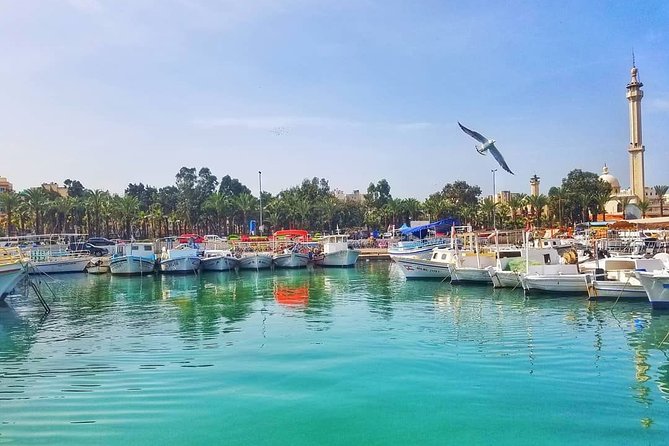
Byblos Castle is the other paid admission of the day. Built by Crusaders in the 12th century over earlier fortifications, it has heavy stone walls, towers, vaulted chambers, and a central courtyard.
The 45-minute visit is generous compared with most of the Tripoli stops. You can explore the interior and climb or walk to viewpoints over the ancient port and nearby countryside. The castle’s value comes from seeing several periods occupy the same hill, with medieval military construction placed over much older remains.
Admission is not included, so remember that the advertised tour price is not the final cost if you enter both paid sites. Still, the castle is the place where the history becomes easiest to picture. From its walls, you can connect the old settlement, the harbor, and the coastal setting in one view.
Byblos Port closes the day with 15 minutes beside one of the world’s oldest ports. It dates back more than 5,000 years and played a major part in Phoenician trade and cultural exchange. Ancient docks and stone quays remain near the modern harbor, where fishing boats and waterfront restaurants bring the area into the present.
The short stop is best for a final walk and photographs. If you want a sit-down seafood meal, you will need to arrange that separately because lunch is not included and the full tour lasts only about six hours.
What the private format is worth
The private arrangement is the main practical advantage. You receive hotel pickup and drop-off, private transportation, an air-conditioned vehicle, and an English-speaking driver. That matters on a day covering two cities north of Beirut, especially when you want to avoid negotiating separate transport for Tripoli and Byblos.
Only your group participates, and group discounts are available. The $50 per-person price becomes more attractive as your party grows, since the vehicle and driver costs are shared. For a couple, it is still a reasonable way to fit both destinations into one day. For a solo visitor, the per-person cost deserves closer comparison with a shared outing.
The tradeoff is that private does not automatically mean slow or deeply guided. The itinerary has many brief stops, and the official description guarantees a driver who speaks English rather than a specialist historian. Hassan is specifically praised for being friendly and well informed, so if you are able to request him, that may be worth asking about. Do not assume availability, though.
The tour is usually booked about 12 days in advance, which suggests planning ahead is sensible. Confirmation is provided when you book, and pickup is offered from your hotel. The tour begins at 9:00 a.m., so have your meeting details ready the night before.
Who should book this tour?
I would recommend this outing to you if you have limited time in Beirut and want a broad look at northern Lebanon. It suits couples, families, and small private groups who value door-to-door transport and want to combine markets, religious buildings, castles, and the sea.
It is also a good choice if authentic city life matters as much as famous sights. Tripoli’s tailors, old khans, bathhouses, sweets, and food markets give the day more texture than a castle-only excursion.
I would hesitate if you prefer long museum visits, leisurely meals, or one city explored in depth. The five-minute stops at several Tripoli sites are necessarily brief, and the total driving time leaves limited room for detours. Anyone with mobility concerns should also ask the provider for current details about walking surfaces and access, since the information supplied says most people can participate but gives no further accessibility description.
Free cancellation is available up to 24 hours before the start time. That gives you useful flexibility, but changes or cancellations inside that window are not accepted for a refund.
Should you book Journey Through Time?
Book it if your priority is seeing a lot in one organized day. The strongest combination is the private vehicle, the two distinct cities, Tripoli’s working souks, the Citadel, and Byblos Castle and port. At $50 per person, it offers good value when shared with a companion or group, even after allowing for the two entrance fees, lunch, and gratuity.
Skip it if you want an unhurried day. This is an introduction with many short visits, not a slow study of Tripoli or Byblos. If Hassan is available, his friendly and informed approach could add real value. Either way, confirm the guide arrangement, entrance costs, and lunch plan before paying. For a first northern Lebanon outing from Beirut, I would consider it a practical and worthwhile choice.
FAQ
What is included in the Tripoli and Byblos tour?
The tour includes an air-conditioned vehicle, an English-speaking driver, private transportation, and hotel pickup and drop-off.
How long does the tour last?
The experience lasts approximately six hours and begins at 9:00 a.m.
Are entrance fees included?
Admission is not included at the Citadel of Saint Gilles in Tripoli or Byblos Castle. Other listed stops have no admission charge specified.
Is lunch included?
No. Lunch is not included in the tour price.
Is this a private tour?
Yes. Only your group participates in the private activity.
Can I cancel for a full refund?
Yes, provided you cancel at least 24 hours before the experience start time. Cancellations or changes made less than 24 hours in advance are not accepted for a refund.
Just added in Beirut
- Wine Tasting Tour★ 5.0 · 2 reviews
- Lebanon tours vip jeitta byblos beirut we charge per vechile not per person.★ 5.0 · 1 review
- Lebanon’s Treasures: Jeita Grotto and Harissa Private Tour★ 5.0 · 2 reviews
- Small Group Tour to Baalbek, Anjar & Ksara with Hotel pickup★ 5.0 · 2 reviews
- Guided Small-Group Tour to Baalbek, Cedars & Qozhaya with Lunch★ 5.0 · 2 reviews
- Small-Group Tour with Lunch to Sidon, Tyre & Maghdouche★ 5.0 · 2 reviews
- Small Group Tours from to Baalbek, Cedars and Qozhaya with lunch and all fees★ 5.0 · 1 review
- Small-Group Tour Qadisha Valley, Becharre and Cedars with Lunch and Tickets★ 5.0 · 1 review
Byblos Tours
Guided Small-Group Tour to Jeita, Harissa, Byblos with Lunch
Read our review →
Jeita Grotto,Harissa&Byblos Full-Day PRIVATE-CAR Trip from Beirut
Read our review →
Byblos, Jeita Grotto & Harissa Day Trip -With Lunch (4G on Board)
Read our review →
Semi-Private Tour to Jeita Grotto, Harissa & Byblos with Lunch
Read our review →
Private Guided Tour to Jeita Grotto through Harissa and Byblos
Read our review →
New Guided Semi-Private Tour to Jeita Grotto, Harissa & Byblos
Read our review →