REVIEW · HISTORICAL TOURS
Exploring Beirut’s Past: A Private Guided Historical Tour
Beirut wears its past in plain sight. This private five-hour tour links the National Museum, Roman ruins, sacred buildings, waterfront views, and Civil War landmarks in one carefully packed morning. I like the comfortable private transport and the chance to shape the pace around your own group. I also like that the route moves beyond ancient sites to modern Beirut’s scars and rebuilding.
The main drawback is the schedule. Many downtown stops receive only ten minutes, while the museum gets two hours, so this is more of a well-guided overview than a slow walking tour. The Holiday Inn and downtown area may also be affected by security conditions, as happened during one recent visit.
In This Review
- Key points to know before booking
- Why this five-hour Beirut tour works
- Two hours inside the National Museum of Beirut
- Sea air at Pigeon Rocks and the Corniche
- A modern waterfront pause at Zaitunay Bay
- The Holiday Inn and Beirut’s wartime scars
- Mohammad Al-Amin Mosque and the city’s religious center
- Al-Omari Mosque, Saint George, and layers of faith
- Martyrs’ Square and Place de l’Étoile
- Beirut Souks and Roman Berytus
- What the guide adds to the route
- Timing, pickup, and who will like it most
- Should you book this Beirut history tour?
- FAQ
- How long does the Beirut historical tour last?
- How much does the tour cost?
- Is hotel pickup included?
- Is the tour private?
- Is transportation provided?
- Is admission to the National Museum included?
- Are meals included?
- Which stop receives the most time?
- When is the tour available?
- What is the cancellation policy?
Key points to know before booking
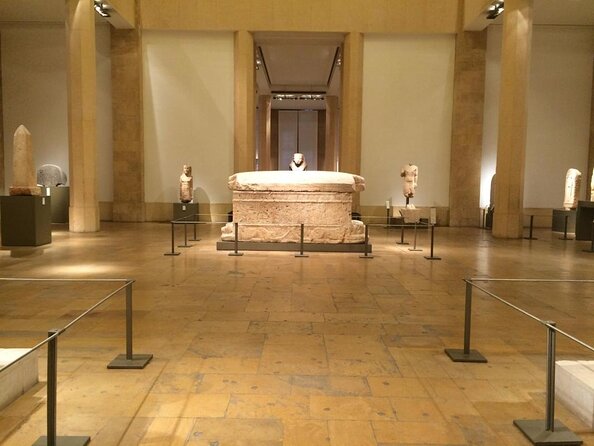
- The National Museum gets the time it deserves: Two hours here provide the tour’s strongest historical foundation, though admission costs extra.
- Private transport keeps a spread-out route practical: Hotel pickup, drop-off, and an air-conditioned vehicle save time between the museum, coast, and city center.
- You see Beirut’s history across several eras: Roman baths, a sixth-century church site, an Ottoman-era mosque, and Civil War landmarks all appear in one outing.
- The Holiday Inn adds difficult modern history: The abandoned hotel remains a stark reminder of the Battle of the Hotels during Lebanon’s Civil War.
- Downtown stops are brief but varied: Mosques, churches, Martyrs’ Square, the old commercial center, and Place de l’Étoile follow in quick succession.
- The guide can make or break the day: Past visitors singled out Pierre, Susan, and driver Nasser for clear explanations, professionalism, and a good sense of humor.
Why this five-hour Beirut tour works
Beirut is not a city you understand from one era alone. Its streets carry Roman, Byzantine, Crusader, Mamluk, Ottoman, French Mandate, modern, and wartime stories, often within a few blocks of one another. This tour gives you a broad first look without asking you to arrange several taxis or sort out the route yourself.
The private format matters. Only your group participates, and hotel pickup and drop-off are included. You ride in a comfortable, air-conditioned vehicle with a tour leader and professional guide, which is useful for a route that runs from the National Museum to the western shore, then back into the downtown core.
I would treat the itinerary as a guided introduction rather than a day of lengthy site visits. The National Museum occupies about two hours. Most other stops last around ten minutes, enough for an explanation, photographs, and a quick look, but not enough for detailed exploration.
The price is $75 per person. That is reasonable if you value a private vehicle, hotel transfers, a dedicated guide, and a five-hour route covering sites that are spread around Beirut. It is less compelling if you want extended time inside each building or prefer to explore independently. Meals are not included, and the museum entrance fee is extra.
More history tours in Beirut:
- PRIVATE Beirut Historical Walking Half Day Tour
★ 5.0 · 27 reviews - Historical Beirut Tour (AM) Half Day – (4G on Board)
★ 4.0 · 16 reviews - Temple of Eshmun – Mleeta Landmark – Beaufort Castle
★ 5.0 · 9 reviews
Two hours inside the National Museum of Beirut
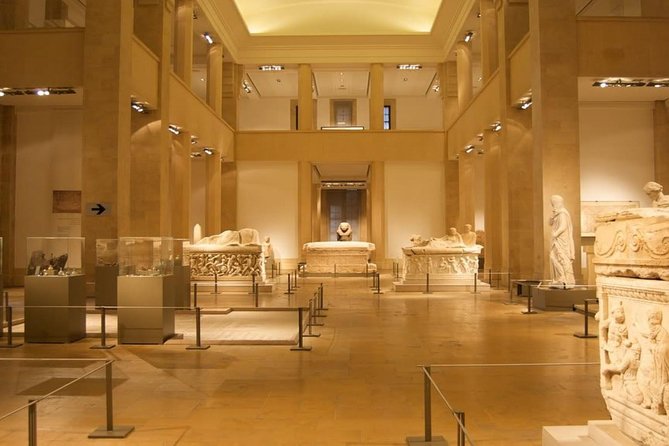
The National Museum is the heart of the tour. It is Lebanon’s principal archaeology museum, with objects gathered from excavations across the country. That makes it the best place to put the rest of the day into context.
You begin with Lebanon as a meeting point of cultures. The collection covers the civilizations that shaped the country, and the guide can help connect museum objects with the places you see later in the city. Without that background, Roman remains, old religious buildings, and downtown monuments can feel like separate pieces. Here, they begin to form a longer story.
The two-hour visit is a strong use of time. Several other stops are short photo and explanation breaks, so this is where you get the fullest historical treatment. One past visitor called the museum the best part of the day, and another found it especially valuable when tight security and protests limited access to central Beirut.
Admission is not included, so budget for that separately. The museum is open Tuesday through Sunday from 8:30 AM to 1:00 PM during the stated operating period, with a special Tuesday schedule listed for part of 2026. Check the current opening information before you go, since the tour depends heavily on a morning museum visit.
Sea air at Pigeon Rocks and the Corniche
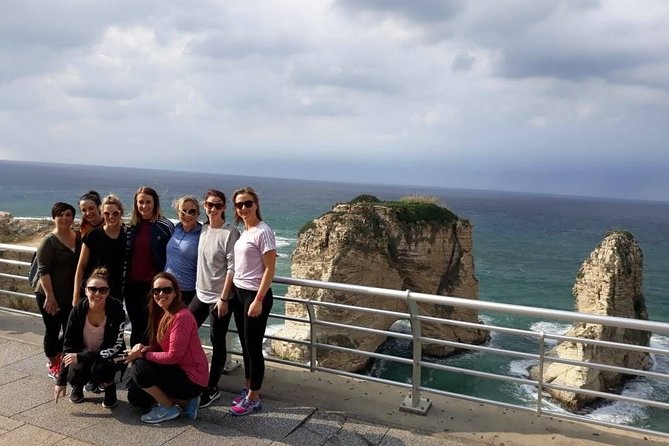
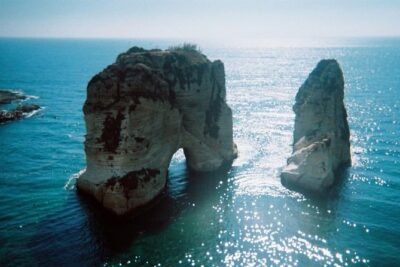
After the museum, the route shifts from archaeology to the Mediterranean coast. Pigeon Rocks in Raouche takes about ten minutes and costs nothing to visit.
The two large rock formations sit at Beirut’s western tip. They are one of the city’s best-known views, and the stop gives you a quick change of mood after the museum’s enclosed galleries. You can take photographs, look out over the water, and hear the guide explain why this point has become such a recognizable part of Beirut.
The nearby Corniche gets another ten minutes. This palm-lined seaside promenade runs from the Ramlet al Bayda area toward the Saint George marina. From here, you can see the Mediterranean, Pigeon Rock, and, on the eastern side, the summits of Mount Lebanon.
Do not expect a long walk along the promenade. The time is enough for a short pause and orientation, not a full coastal stroll. If sea views matter to you, these stops are useful. If your priority is ancient architecture, they may feel brief.
A modern waterfront pause at Zaitunay Bay
Zaitunay Bay presents another side of Beirut. The waterfront promenade has shops and restaurants and is promoted as a major leisure destination in the city.
The stop lasts around ten minutes and is free. It works mainly as a quick look at modern waterfront Beirut, contrasting with the museum and older central buildings. You will not have time for a meal here, so do not count on this stop as a dining break.
That contrast is one of the route’s strengths. Beirut is not presented only as an archaeological site. You also see the city as a contemporary commercial and social center. Still, the short stop means you should see Zaitunay Bay as an orientation point, not a shopping or restaurant visit.
A completely different kind of day out:
- Guided Small-Group Tour to Baalbek, Anjar and Ksara with Lunch
★ 5.0 · 511 reviews - Guided Small-Group Tour to Jeita, Harissa, Byblos with Lunch
★ 5.0 · 361 reviews - Paragliding Trip Over Lebanon – Jounieh Bay
★ 5.0 · 257 reviews - Jeita Grotto,Harissa&Byblos Full-Day PRIVATE-CAR Trip from Beirut
★ 5.0 · 222 reviews
The Holiday Inn and Beirut’s wartime scars
The abandoned Holiday Inn is the most emotionally difficult stop. Built between 1971 and 1974, when Beirut was enjoying a major economic and tourist boom, the hotel operated only briefly before the Lebanese Civil War began in 1975.
The building became part of the Battle of the Hotels, a long fight for control of luxury hotels in central Beirut. More than 25,000 combatants were involved in the conflict around several properties, including the Holiday Inn and the Phoenicia hotel.
The structure remains empty and untouched decades after the war. Its damaged shell is not a polished monument, and that is precisely why it carries weight. You see a direct reminder of how quickly a prosperous city can be pulled into violence.
This part of the tour benefits from a thoughtful guide. The facts are stark, and the stop deserves more than a quick photograph. The schedule does not state a separate duration for the Holiday Inn, so expect the guide to explain it as part of the driving route or a short viewing stop.
Mohammad Al-Amin Mosque and the city’s religious center
The Mohammad Al-Amin Mosque, also called the Blue Mosque, is in downtown Beirut near Martyrs’ Square. Opened in 2008, it is Lebanon’s largest mosque.
The building is easy to recognize by its amber-colored exterior, four minarets rising 65 meters, light-blue tiled domes, and tall arches. The ten-minute stop gives you time to appreciate its scale and position in the center of the city.
This is an exterior-focused visit unless the guide advises otherwise. Admission is listed as free, but the schedule does not promise interior access. Dress and behavior should be respectful around any religious site, and your guide is the right person to ask about current visiting conditions.
The mosque also helps show the range of Beirut’s religious architecture. Within a short distance, the route takes you from a modern Islamic landmark to a much older mosque and then to a Greek Orthodox cathedral.
Al-Omari Mosque, Saint George, and layers of faith
Al-Omari Grand Mosque carries several chapters of Beirut’s past. It was built in 635 AD during the age of Omar Bin El Khattab, converted into the Church of Saint John by Crusaders in the twelfth century, and returned to use as the city’s Grand Mosque under the Mamluks in 1291.
The Civil War damaged the building, and restoration finished in 2004. That repair is part of the site’s meaning. You are not looking at an untouched medieval structure, but at a religious building that survived conflict and was brought back into use.
The visit lasts about ten minutes and is free. The short timing is enough for a guide’s historical outline, but not for a detailed architectural study.
The Greek Orthodox Cathedral of Saint George follows the same pattern of layered history. It is the seat of the Greek Orthodox Metropolitan bishop of Beirut and is described as the city’s oldest church. The first Christian temple on this site dates to the mid-sixth century and is linked with Beirut’s famous Law School.
Again, the stop is about ten minutes. You gain a useful sense of how closely different faiths and historical periods overlap in central Beirut. You should not expect a long interior visit or a full religious tour.
Martyrs’ Square and Place de l’Étoile
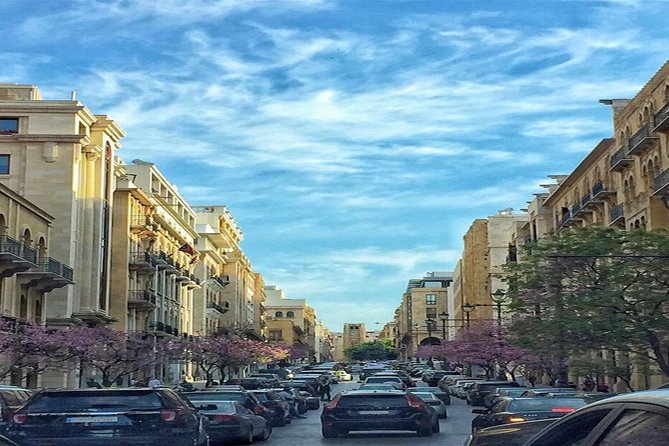
Martyrs’ Square sits in the center of downtown. It was once known as Al Burj or Place des Cannons, and its current name recalls the executions of Lebanese nationalists by the Ottomans on May 6, 1916, during World War I.
A ten-minute stop here gives you a place to connect Ottoman rule, Lebanese nationalism, and the political importance of central Beirut. The square has also experienced the effects of war, protest, and redevelopment, so the guide’s explanation matters more than the brief visit itself.
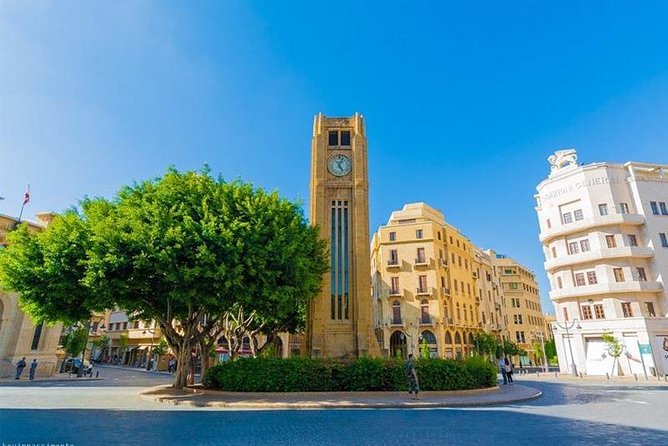
Place de l’Étoile, also called Nejme Square, is another ten-minute stop. It is home to the Lebanese Parliament and related buildings, two cathedrals, a museum, cafes, and restaurants.
The square is especially known for its 1930 four-faced Rolex clock and its European-style architecture. It is one of the easiest places to recognize Beirut’s formal downtown plan. The tour gives you the outline, while a later independent walk would allow you to linger in the cafes or examine the buildings more closely.
Beirut Souks and Roman Berytus
Beirut Souks brings the route into a commercial district with more than 200 shops, 25 restaurants and cafes, an entertainment center, and a cinema complex. It is described as the largest and most varied shopping and leisure area in Beirut.
The stop lasts about ten minutes, so you will not shop in any serious way. Instead, you see how the downtown area functions as a modern retail center after the older religious and political landmarks.
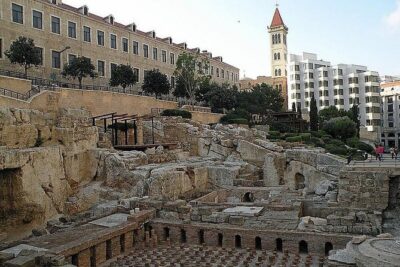
The final listed stop is the Roman Baths, one of the most important open-air archaeological sites in downtown Beirut. The baths were found in 1968 and 1969 and underwent major renovation in the mid-1990s.
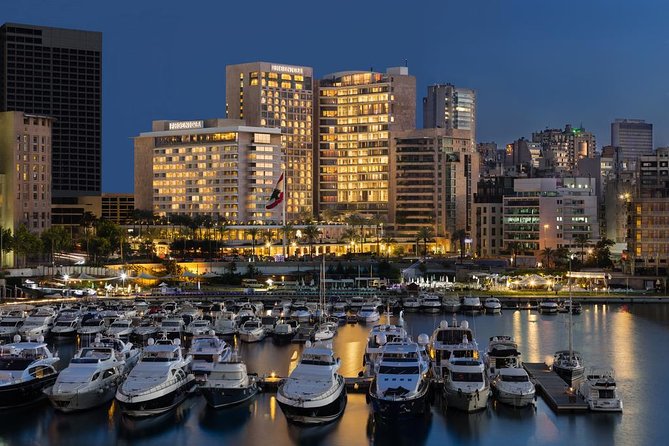
Ancient Berytus had four major bath complexes. The first was created in the early first century under Augustus. A major earthquake in 551 AD destroyed the baths, leaving the remains you see today.
One bath area now serves as a space for artistic performances and concerts. That continued public use gives the ruins a practical role rather than leaving them as a fenced-off relic. The visit is listed at ten minutes and free, so listen closely to the guide’s explanation and take time to notice the layout.
What the guide adds to the route
A good guide is essential here because the schedule moves quickly. The sites are not difficult to recognize, but their connections are easy to miss. The value lies in hearing how a Roman bath, a Crusader church, an Ottoman mosque, a modern mosque, and a war-damaged hotel fit into Beirut’s story.
Pierre guided two of the praised tours and was described as professional and especially informative. Susan and driver Nasser were also singled out for making the day enjoyable and good-humored. The operator is Beirut Daily Tours, and the private setup means your group has a better chance of asking questions than it would on a large coach excursion.
One practical warning: conditions in central Beirut can change. During one visit, security concerns and protests prevented access to the city center, so the National Museum became the main focus. That is not a flaw unique to this tour, but you should accept that the exact route may need to change.
Timing, pickup, and who will like it most
The tour lasts approximately five hours and includes hotel pickup and drop-off. Private transportation is particularly useful because the route covers the museum, Raouche, the waterfront, and downtown rather than keeping you in one compact district.
The tour is a good fit for you if:
- You want a first introduction to Beirut’s history without arranging transport yourself.
- You enjoy seeing ancient sites alongside modern city life and wartime reminders.
- You prefer a private guide and vehicle to a large group.
- You want a substantial museum visit as part of a half-day outing.
- You have limited time in Beirut and want broad coverage.
It is less suitable if you want long visits inside churches and mosques, a full shopping session, or a relaxed seaside walk. The itinerary is packed, and ten-minute stops require you to keep moving.
Confirmation is provided at booking, most people can participate, and the activity is private. Free cancellation is available if you cancel at least 24 hours before the start time. Inside 24 hours, the amount paid is not refunded, and changes are not accepted.
Should you book this Beirut history tour?
I would book it if you want Beirut’s major themes in one practical half-day: archaeology, religion, the sea, commerce, politics, and the physical remains of war. The National Museum is the strongest part, and the private transport adds real value at $75 per person.
I would skip it if your ideal day means lingering at every site. For the best experience, go in expecting a guided overview, ask the guide to expand on the subjects that interest you, and keep a separate block of time for any downtown place you want to explore properly.
FAQ
How long does the Beirut historical tour last?
The tour lasts approximately five hours.
How much does the tour cost?
The listed price is $75 per person.
Is hotel pickup included?
Yes. Hotel pickup and drop-off are included.
Is the tour private?
Yes. Only your group participates in the activity.
Is transportation provided?
Yes. The tour includes private transportation in a comfortable, air-conditioned vehicle.
Is admission to the National Museum included?
No. Admission to the National Museum of Beirut is not included in the tour price.
Are meals included?
No. Meals are not included.
Which stop receives the most time?
The National Museum of Beirut receives approximately two hours. Most other listed stops last about ten minutes.
When is the tour available?
During the stated operating period, it runs Tuesday through Sunday from 8:30 AM to 1:00 PM. A separate Tuesday-only schedule is listed for April 1, 2026, and another Tuesday through Sunday period runs from April 2 through June 18, 2026.
What is the cancellation policy?
You can cancel at least 24 hours before the start time for a full refund. Cancellations and changes made less than 24 hours before the tour are not accepted for a refund.
Just added in Beirut
- Wine Tasting Tour★ 5.0 · 2 reviews
- Lebanon tours vip jeitta byblos beirut we charge per vechile not per person.★ 5.0 · 1 review
- Lebanon’s Treasures: Jeita Grotto and Harissa Private Tour★ 5.0 · 2 reviews
- Journey Through Time: A Private Tour of Tripoli and Byblos★ 5.0 · 1 review
- Small Group Tour to Baalbek, Anjar & Ksara with Hotel pickup★ 5.0 · 2 reviews
- Small-Group Tour with Lunch to Sidon, Tyre & Maghdouche★ 5.0 · 2 reviews
- Guided Small-Group Tour to Baalbek, Cedars & Qozhaya with Lunch★ 5.0 · 2 reviews
- Small-Group Tour Qadisha Valley, Becharre and Cedars with Lunch and Tickets★ 5.0 · 1 review
Historical Tours
Historical Beirut Tour (AM) Half Day – (4G on Board)
Read our review →
Sidon & Tyre Unesco Heritage w/pick-up, guide, entries+lunch
Read our review →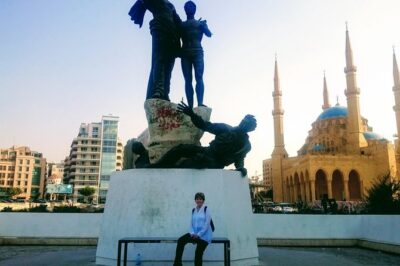
PRIVATE tour to Beirut history museum, Beiteddine & Deir elQamar
Read our review →
Baalbek, Anjar & Wine: A Journey Through Lebanon’s Heritage
Read our review →