REVIEW · CITY TOURS
Small Daily Tours in Beirut City
Beirut comes with layers. This three-hour tour gives you a quick, useful introduction to the city, moving from Raouche Rocks and the Mediterranean waterfront to downtown mosques, churches, war ruins, and Roman remains. I like the hotel pickup and drop-off anywhere in Beirut, and I like the small-group limit of 15 people, which should feel more personal than a large coach outing.
The air-conditioned vehicle also matters in Beirut, where several major sights are spread across the city. The main caution is timing: ten-minute visits are enough for photos and a short explanation, but not for a slow, detailed look. Also, the tour description says National Museum admission is included, yet the listed route does not show a museum stop, so confirm that point before booking.
In This Review
- Key points to know before booking
- Why this three-hour Beirut tour can be useful
- Raouche Rocks and the Corniche: Beirut meets the sea
- Zaitunay Bay and the city’s polished waterfront
- The Holiday Inn: a hard look at the civil war
- Mohammad Al-Amin Mosque and Martyrs’ Square
- Al-Omari Mosque and Saint George Cathedral
- Place de l’Étoile and the Roman Baths
- The National Museum question matters
- The guide, vehicle, and group size
- Who will get the most from this tour?
- Is $65 a fair price?
- Should you book Small Daily Tours in Beirut City?
- FAQ
- How long does the Beirut city tour last?
- What time does the tour start?
- Is hotel pickup included?
- What is the maximum group size?
- Is lunch included?
- Is National Museum admission included?
Key points to know before booking
- Raouche Rocks opens the tour with Beirut’s best-known seaside view, a fast but memorable introduction to the city.
- The route moves from coast to downtown, helping you see Beirut as both a Mediterranean port and a historic capital.
- The abandoned Holiday Inn adds difficult modern history, rather than presenting only polished monuments.
- Mohammad Al-Amin Mosque, Al-Omari Mosque, and Saint George Cathedral show Beirut’s religious mix within a compact central area.
- The maximum group size is 15, a reasonable middle ground between a private guide and a large bus.
- National Museum admission is said to be included, but the supplied stop list does not clearly include the museum, so ask the operator to clarify.
Why this three-hour Beirut tour can be useful
Beirut is not a city you understand from one postcard view. Its waterfront, rebuilt downtown, Ottoman-era memory, Roman remains, churches, mosques, and civil-war scars all sit within a relatively compact urban area, but they are not arranged as one tidy open-air museum.
This tour is designed to help you get your bearings fast. You are collected at your hotel at about 8:30 a.m., then driven between sights in an air-conditioned vehicle with an English-speaking driver or tour leader. That setup saves time and avoids the strain of working out every transfer on your first morning.
At $65 per person, the price is not simply paying for entrance to monuments. The value is in the transport, hotel transfers, English-language assistance, and the amount of ground covered in half a day. If you had to arrange separate rides to Raouche, downtown, and the central archaeological sites, the convenience would quickly become part of the cost.
Still, this is a city orientation tour, not a full museum visit or a long walking tour. The listed stops are generally allotted about ten minutes each. You will see a lot, but you will also need to accept quick visits, exterior views, and short explanations.
The wording describes a private vehicle, while the group can include up to 15 people. I would read that as a vehicle reserved for the tour rather than a guaranteed private tour for just you and your party. If a private experience is essential, ask before paying.
More city tours in Beirut:
- City Sightseeing Beirut Hop-On Hop-Off Bus Tour
★ 4.5 · 87 reviews - PRIVATE city Tour of authentic Tripoli and vibrant Batroun
★ 5.0 · 51 reviews - Private Baalbek City Tour
★ 5.0 · 14 reviews
Raouche Rocks and the Corniche: Beirut meets the sea
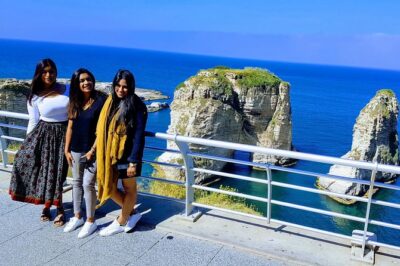
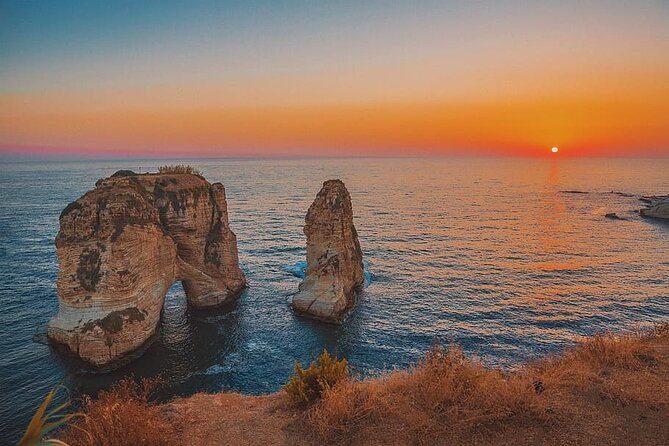
The tour begins at Raouche Rocks, also called Pigeon Rock, on Beirut’s western tip. Two enormous rock formations rise from the water like natural sentries, and they are among the city’s most recognizable sights.
The official stop is about ten minutes, with no admission fee. That is enough to take in the view and get photographs, though it is short if you want to linger by the shore or study the rocks from different angles. I would have your camera ready before leaving the vehicle.
From there, the route follows the Al Manara Corniche. This seaside promenade stretches from the Ramlet al Bayda area toward the Saint George marina and gives you a wider sense of Beirut’s coastal setting. Palm trees, the Mediterranean, Pigeon Rock, and the summits of Mount Lebanon can all enter the view, depending on the exact stopping point and visibility.
This part of the journey is more than a scenic extra. It shows why Beirut developed as a major port city and gives you a contrast to the dense central districts later in the morning. The drawback is that the tour description does not give a separate time allowance for the Corniche, so you may see it mainly from the vehicle.
Zaitunay Bay and the city’s polished waterfront
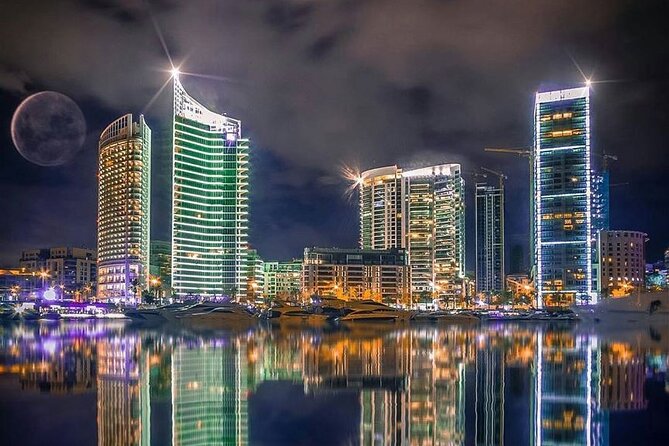
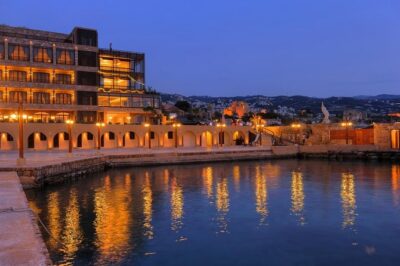
Zaitunay Bay is a newer waterfront promenade with shops and restaurants. It offers a different side of Beirut from Raouche: planned, modern, and geared toward leisure.
There is no stated admission fee, and no separate duration is given. Treat it as a passing stop or short orientation point rather than a meal break. Lunch is not included, and the whole tour lasts only around three hours, so you should not expect time to sit down for a full meal here.
I like having this contrast in the route. Beirut is not only ancient ruins and war memorials. Its newer waterfront shows how the city continues to rebuild and present itself as a place for dining, walking, and city life.
The Holiday Inn: a hard look at the civil war
The abandoned Holiday Inn is one of the most striking modern landmarks on the route. Built between 1971 and 1974, when Beirut was enjoying a strong economic and tourism boom, the hotel became part of the Battle of the Hotels after the Lebanese Civil War began in 1975.
The fighting involved control of major luxury hotels, including the Holiday Inn and the Phoenicia. More than 25,000 combatants were involved in the wider conflict described in the tour material. The Holiday Inn was left abandoned and visibly damaged, making it a powerful reminder of what war did to Beirut’s central districts.
This is not a pretty photo stop, and that is exactly why it belongs on a serious introduction to the city. It helps you understand that Beirut’s past is not confined to ancient history. Modern conflict is still written into the buildings.
The tour does not list a set time here. You will probably view the hotel from outside, and the amount of explanation may depend on your driver or tour leader. If this subject matters greatly to you, ask for context rather than assuming the stop will become a detailed history lesson.
A completely different kind of day out:
- Guided Small-Group Tour to Baalbek, Anjar and Ksara with Lunch
★ 5.0 · 511 reviews - Guided Small-Group Tour to Jeita, Harissa, Byblos with Lunch
★ 5.0 · 361 reviews - Paragliding Trip Over Lebanon – Jounieh Bay
★ 5.0 · 257 reviews - Jeita Grotto,Harissa&Byblos Full-Day PRIVATE-CAR Trip from Beirut
★ 5.0 · 222 reviews
Mohammad Al-Amin Mosque and Martyrs’ Square
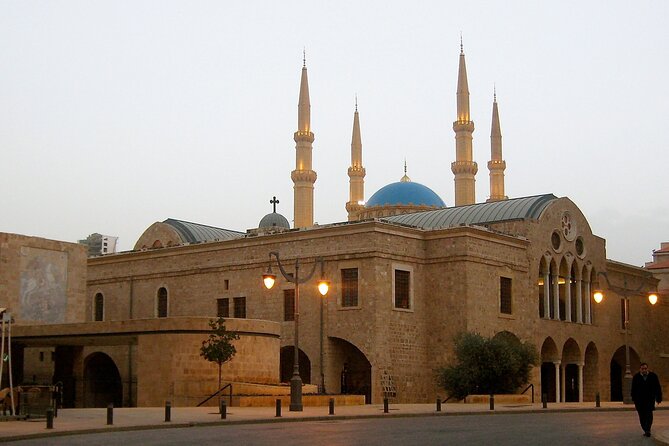
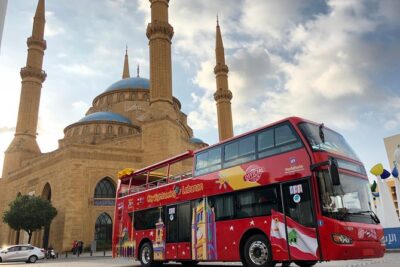
In downtown Beirut, the blue-domed Mohammad Al-Amin Mosque is an immediate visual landmark. It is the largest mosque in Lebanon and opened in 2008. Its amber-colored exterior, light blue tiled domes, tall arches, and four minarets, each reaching about 65 meters, make it easy to recognize from the surrounding streets.
The stop lasts about ten minutes and has no listed admission fee. That is suitable for a first look at the exterior and a short explanation of the building. If you hope to enter, dress and behave respectfully, and ask the tour leader about current access rules. The provided information does not promise interior access.
The mosque sits near Martyrs’ Square, a place with a much older political memory. The square was historically known as Al Burj or Place des Cannons. Its current name recalls the executions of Lebanese nationalists by the Ottoman authorities on May 6, 1916, during World War I.
Ten minutes here can introduce the story, but it cannot explain every period of the square’s past. I would listen for the link between the Ottoman executions, Lebanese nationalism, and the square’s role as a central public space. The point is not just to photograph an open plaza. It is to understand why this location carries such weight.
Al-Omari Mosque and Saint George Cathedral
The Al-Omari Grand Mosque gives the tour another strong example of Beirut’s changing religious and political history. Its origins are connected with the age of Omar Bin El Khattab in 635 AD. Crusaders later converted it into the Church of Saint John, and the Mamluks turned it back into the city’s grand mosque in 1291.
The building was damaged during the Lebanese Civil War, and restoration was completed in 2004. That recent repair is important. You are not looking at an untouched medieval structure, but at a place that has been altered, damaged, and brought back into use.
The listed visit is about ten minutes. I would focus on the sequence of changes rather than expect a long architectural tour. The value comes from seeing how one building can reflect several ruling periods and religious traditions.
Nearby, Saint George Greek Orthodox Cathedral adds another layer. It is the seat of the Greek Orthodox Metropolitan bishop of Beirut and is described as the oldest church in the city. A Christian temple occupied this location by the mid-sixth century, and the site is linked with Beirut’s famous Law School.
The church’s position in the city center makes the pairing with the mosques especially useful. You do not need a long transfer or a formal lecture to see that Beirut’s central district has long brought different religious communities close together.
Place de l’Étoile and the Roman Baths
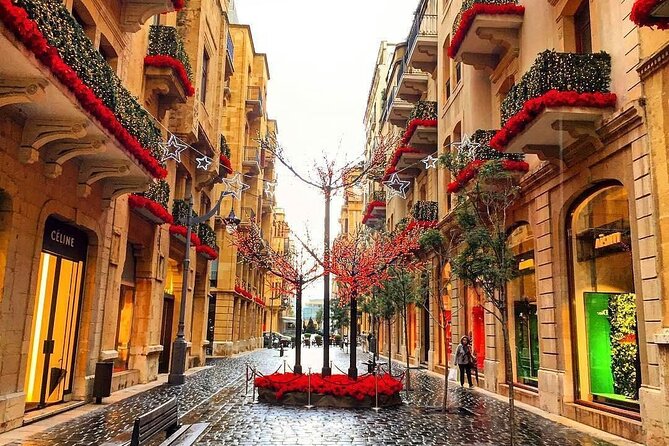
Place de l’Étoile, also called Nejme Square, is the central square of the downtown area. The Lebanese Parliament and related buildings, two cathedrals, a museum, cafes, and restaurants are located around or near this district.
Its most famous object is the four-faced Rolex clock dating from 1930. The square’s architecture and clock have become familiar symbols of Beirut, so this is another quick stop that works well as part of a first visit.
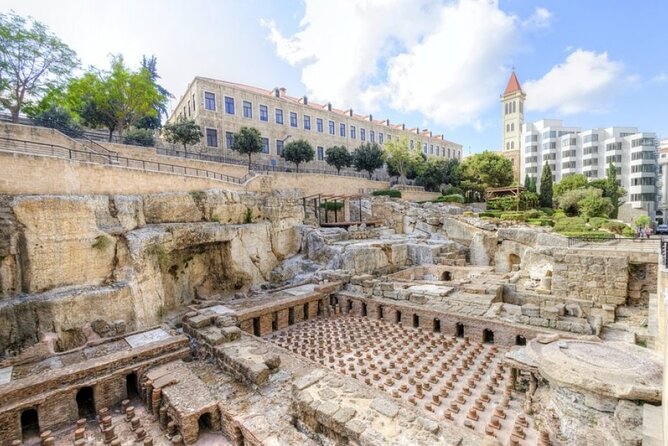
The route then reaches the Roman Baths, one of the most important outdoor archaeological sights in central Beirut. The remains were discovered in 1968 and 1969 and underwent major renovation in the mid-1990s.
Ancient Berytus had four major bath complexes. The first was created in the early first century under Augustus, and all the baths were destroyed by the devastating earthquake of 551 AD. Today, the site helps you picture Roman public life, where bathing was social, practical, and central to city culture.
The Roman Baths are not a vast ruin field, so ten minutes can be enough for a first look. One bath complex is also used for artistic performances and concerts, giving the remains a role in present-day Beirut rather than leaving them as silent stones.
The stop list calls this the parking area for the Roman Baths, which may mean the vehicle pauses nearby while you view the ruins. If you want a full archaeological visit, confirm how much time is actually available.
The National Museum question matters
The tour description says admission tickets to the National Museum of Beirut are included. That could add real value, since a museum visit would help connect the city’s Roman remains with Lebanon’s wider archaeological story.
But the route supplied for this experience lists Raouche Rocks, the Corniche, Zaitunay Bay, the Holiday Inn, the central religious sites, Place de l’Étoile, and the Roman Baths. It does not clearly list the National Museum as a separate stop, and the total duration remains about three hours.
That creates a practical question. Is the museum included as a brief stop, is admission available for use at another time, or is the description combining two versions of the tour? I would contact Lebanon Daily Tours before booking and ask exactly how the museum ticket is handled.
Do not assume that included admission means you will receive a full museum visit. A ten-minute stop would not be enough for that.
The guide, vehicle, and group size
The tour includes hotel pickup and drop-off from anywhere in Beirut, an air-conditioned vehicle, and a tour leader. The starting time is about 8:30 a.m., which gives you a useful morning block without taking a full day from your schedule.
The maximum group size is 15. That is small enough for a more relaxed feel than a big bus, though it is not the same as a private guide for two or four people. Your experience will depend partly on how many people actually book that day.
English-language support is promised. The provider has also been associated with a guide named Imad. In related feedback, he was described as arriving exactly on time, putting a solo woman at ease, and speaking excellent English. Since guide assignments can change, treat Imad as a useful name to request, not a guaranteed part of every booking.
The comments about punctual pickup and comfort are especially relevant here. Beirut is easier to enjoy when you are not starting the day by negotiating unfamiliar transport. Still, a driver-led tour may offer less detail than a licensed specialist guide, so ask who will lead the sightseeing and how much walking or explanation is planned.
Who will get the most from this tour?
I would choose this tour if you are visiting Beirut for the first time and have only a short window. It covers the city’s best-known coastal view, central landmarks, Roman remains, religious buildings, and a major civil-war site in one morning.
It also suits you if you value hotel transfers and want to avoid arranging several rides. The air conditioning is a practical benefit, especially when moving between scattered sights.
Solo visitors may appreciate the pickup and small group. Families and older visitors may also like the limited walking between locations, though the itinerary does not provide detailed accessibility information. Most people can participate, according to the supplied details, but you should ask directly about vehicle access and walking conditions if those are important to you.
I would hesitate if you prefer long museum visits, quiet photography, or detailed architectural study. The ten-minute stops keep the tour moving, but they also limit time inside or around each site. I would also hesitate if the National Museum is your main reason for booking until its place in the schedule is confirmed.
Is $65 a fair price?
At $65 per person, the tour is reasonably priced for a three-hour city introduction that includes hotel pickup, return transport, an air-conditioned vehicle, an English-speaking tour leader, and a group limit of 15.
The strongest value comes from the logistics. You see coastal Beirut and downtown Beirut without paying separately for several transfers, and you can fit the tour into the first morning of a longer stay.
The value is weaker if you are staying close to the central sights and already have easy transport. In that case, you may prefer to spend the same money on a longer guided visit to one museum or historic area.
The National Museum admission could improve the deal, but only if it genuinely includes a visit. Confirm that detail before you compare the price with other Beirut activities.
Should you book Small Daily Tours in Beirut City?
Book it if you want a fast, sensible first look at Beirut with hotel transfers and a manageable group. The mix of sea views, mosques, cathedral, Roman ruins, downtown squares, and the battered Holiday Inn gives you more context than a sightseeing loop focused only on attractive buildings.
Do not book it expecting a slow cultural tour. The schedule is tight, several stops last only ten minutes, and the museum arrangement needs clarification. Ask whether the vehicle is shared, whether Imad is available, and how the National Museum fits into the three-hour route.
For a first morning in Beirut, I see this as a useful orientation rather than the final word on the city. It helps you decide which places deserve a longer return visit.
FAQ
How long does the Beirut city tour last?
The tour lasts approximately three hours.
What time does the tour start?
The listed start time is 8:30 a.m.
Is hotel pickup included?
Yes. Hotel pickup and drop-off from anywhere in Beirut are included.
What is the maximum group size?
The tour can include a maximum of 15 people.
Is lunch included?
No. Lunch is not included in the tour price.
Is National Museum admission included?
The tour information says admission tickets to the National Museum of Beirut are included, but the listed route does not clearly show a museum stop. Confirm how and when the ticket is used before booking.
Just added in Beirut
- Guided Full-Day Private Trip to Tripoli from Beirut★ 5.0 · 2 reviews
- Guided Half-Day Private Trip to Beiteddine Palace and Deir el Qamar★ 5.0 · 2 reviews
- Guided Half-Day Private Trip to Byblos from Beirut★ 5.0 · 1 review
- Discovering Tyre: A Half-Day Tour with English-Speaking Driver★ 5.0 · 1 review
- Beirut to Beiteddine and Deir El Qamar: Daily Tours with Lunch★ 5.0 · 2 reviews
- Customized as you like day tour in lebanon anywhere from 1-6 riders same price★ 5.0 · 1 review
- Semi-Private Guided Tour to Baalbek, Anjar and Ksara with lunch★ 5.0 · 2 reviews
- Private Trip to Beiteddine Palace, Deir elQamar and Mousa Castle★ 5.0 · 2 reviews
City Tours
PRIVATE city Tour of authentic Tripoli and vibrant Batroun
Read our review →
PRIVATE tour to Jeita Grottos, Harissa Shrine & Byblos City
Read our review →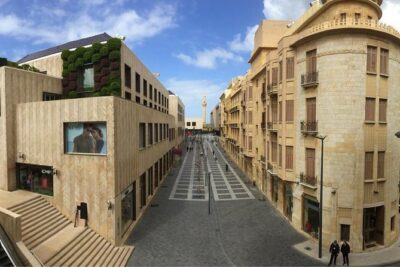
Private Beirut City Tour with Boat Ride at Raouche Rock
Read our review →