REVIEW · BAALBEK ANJAR AND KSARA DAY TRIPS
Exploring the Qadisha Valley, Cedars of God, and Baalbek Temples
Three Lebanese icons, one long day. This private tour links the Qadisha Valley and Cedars of God with the Roman temples of Baalbek, giving you an unusually broad look at Lebanon in about eight hours. I like the door-to-door pickup and comfortable air-conditioned vehicle, and I like the mix of mountain scenery, Christian heritage, local culture, and ancient ruins.
The main drawback is the packed schedule. Qadisha Valley and Baalbek each deserve more time than a quick visit, and Baalbek’s admission fee is not included in the $150 price. Still, a private group and a local guide in Baalbek make this a practical choice if you want to cover several major sites without arranging transport yourself.
In This Review
- Key points to know before booking
- Why this day trip is unusual
- Entering the Qadisha Valley
- Bcharre, churches, Gibran, and mountain life
- Meeting the Cedars of God
- Baalbek’s enormous Roman temples
- The Stone of the Pregnant Woman
- What the transportation and schedule mean
- Who should choose this tour?
- Is the $150 price good value?
- Should you book it?
- FAQ
- How long does the tour last?
- Is hotel pickup and drop-off included?
- Is this a private tour?
- Is transportation included?
- Is lunch included?
- Is the Baalbek entrance ticket included?
- Can I cancel for a full refund?
Key points to know before booking
- A private tour from Beirut: Only your group participates, with hotel pickup and drop-off included.
- Three very different places: You move from a sacred mountain valley to ancient cedar trees, then to some of the grandest Roman ruins in the region.
- Baalbek gets the most planned sightseeing time: Allow about 1 hour and 30 minutes for the temple complex, plus 15 minutes at the Stone of the Pregnant Woman.
- Bcharre adds cultural context: The mountain town is linked with Khalil Gibran, Lebanon’s cedar heritage, churches, and its long-standing ski tradition.
- The $150 price includes transport and guides: Lunch and the Baalbek entrance ticket cost extra.
- Paula earned special praise: One detailed rating specifically highlights Paula’s ability to explain the sites and keep the group engaged.
Why this day trip is unusual
Many day trips from Beirut focus on one type of sight. This one does not. In a single outing, you see a valley shaped by a river, a small surviving grove of ancient cedars, a mountain town with strong religious and artistic ties, and a Roman complex built on a huge scale.
That variety is the tour’s greatest strength. You are not spending eight hours looking at similar ruins or taking only scenic photographs. The day moves between nature, faith, art, and imperial architecture.
The tour also gives you private transportation rather than placing you in a large shared group. That matters on a long road day. Your party can travel together, collect you from your hotel in Beirut, and return you there without making your own way back after a tiring sightseeing schedule.
The experience is listed at $150 per person. I would judge that price mainly by how much you value convenience. It includes a private air-conditioned vehicle, a tour leader, a local guide in Baalbek, and hotel pickup and drop-off. Lunch and the Baalbek admission fee are extra, so you should budget for those separately.
For a person who wants to visit all three areas independently, transport planning would be the difficult part. The private format removes much of that work. For someone already renting a car or staying near the sites, the price may feel less attractive.
More Baalbek and Bekaa day trips:
- Guided Small-Group Tour to Baalbek, Anjar and Ksara with Lunch
★ 5.0 · 511 reviews - Anjar, Baalbek & Ksara Day Trip – With Lunch (4G on Board)
★ 4.5 · 181 reviews - Baalbek – Anjar – Ksara Trip From Beirut
★ 4.5 · 80 reviews
Entering the Qadisha Valley
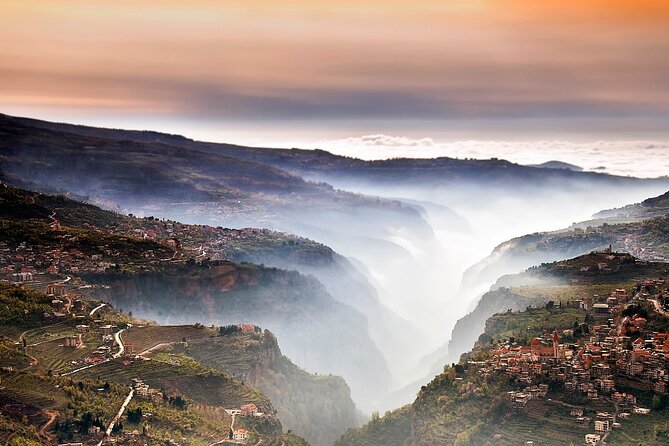
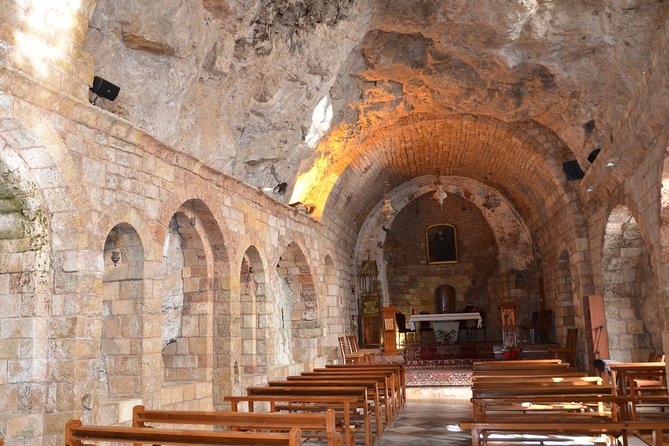
The Qadisha Valley is known as the Holy Valley. The Qadisha River cut the deep valley through the mountains, leaving steep cliffs, thick plant life, and a chain of old monasteries and religious retreats.
For centuries, monks used this remote setting for quiet and spiritual life. The valley’s importance is not only religious. It also shows how people adapted to a rugged mountain environment, building places of worship in hard-to-reach spaces.
The appeal here is mood rather than a single famous monument. You get quiet mountain views, rock walls, greenery, and traces of a long tradition of retreat. If you like sacred places that still feel connected to their setting, this part of the day may be the most memorable.
You should keep expectations realistic. The supplied schedule gives no fixed length for the general Qadisha Valley stop, and the whole outing lasts about eight hours. That means your time may focus on viewpoints and selected sites rather than a long hike through the valley.
Wear shoes that are comfortable on uneven ground. That is practical advice for any visit involving a steep mountain valley, even though the exact walking route is not specified. Ask your tour leader how much time is planned on foot before leaving the vehicle.
Bcharre, churches, Gibran, and mountain life
Bcharre is the main town connected with the Cedars of God. It is also the birthplace of Khalil Gibran, the Lebanese poet, painter, and sculptor. His former presence gives the town an artistic identity that adds another layer to a day otherwise focused on nature and ancient buildings.
Bcharre has a museum honoring Gibran, but the tour information does not say that museum admission or a visit is included. If Gibran is important to you, ask before departure if there is enough time to enter. The stated stop lasts about 30 minutes and has no admission charge listed.
The town is also called the city of churches because it has about 37 churches. That detail helps explain the close connection between Bcharre and the Qadisha Valley’s religious tradition. Even a short stop can help you see that this is not simply a gateway to a forest. It is a mountain community with a strong spiritual and cultural identity.
Bcharre also has Lebanon’s oldest skiing area, the Cedars Ski Resort. Lebanon’s first ski lift was built here in 1953. This may seem like an unexpected fact beside monasteries and cedar trees, but it shows how the area has developed as both a place of worship and a mountain resort.
At only 30 minutes, Bcharre is a brief orientation stop rather than a full town visit. I would treat it as a chance to understand the area and connect the next two sights, not as time for a long museum visit, extended shopping, or a relaxed meal.
Meeting the Cedars of God
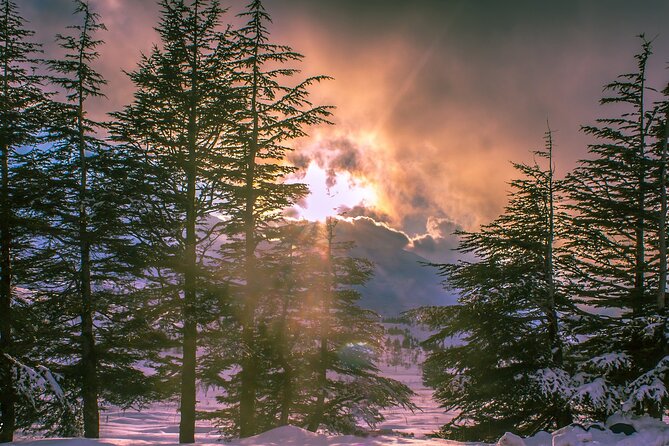
The Cedars of God are the emotional center of the mountain portion of the tour. These old trees are among Lebanon’s strongest national symbols, and the preserved grove is associated with the country’s name, identity, and long connection to cedar wood.
Some of the trees are thousands of years old. Their age is difficult to grasp until you stand beside their broad trunks and look up through the branches. The forest’s value comes from both its natural presence and its place in Lebanese culture.
The visit is scheduled for about 30 minutes, with no admission fee listed. That is enough for a short walk and photographs, but it is not a long forest outing. If you want a slow stroll beneath the trees, you may find the time tight, especially after the drive from Beirut and the stop in Bcharre.
I like that the tour pairs the forest with Qadisha Valley. The two sites explain each other. The valley shows the religious setting, while the cedar grove represents the natural symbol that Lebanon has worked to protect. Seeing both is more useful than visiting the trees alone.
The forest is also a good counterpoint to Baalbek. The Roman temples are made from enormous blocks of stone and carefully carved architectural parts. The cedars are living monuments. One is human-made and imperial, the other natural and enduring.
More of the Qadisha Valley and the Cedars:
- Guided Small-Group Tour to Qadisha, Bcharee & Cedars with Lunch
★ 5.0 · 39 reviews - Cedars of Lebanon, Qozhaya, & Bcharre – With Lunch (4G on Board)
★ 4.5 · 34 reviews - Cedars, Bsharre & Kozhaya Day Tour
★ 5.0 · 15 reviews - Guided small group to Cedars Reserve & Beiteddine w/lunch+entries
★ 5.0 · 12 reviews
Baalbek’s enormous Roman temples
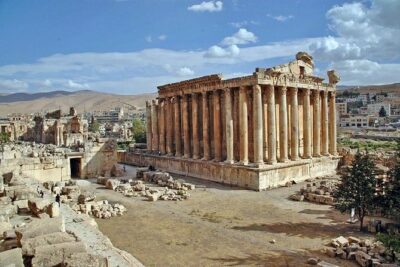
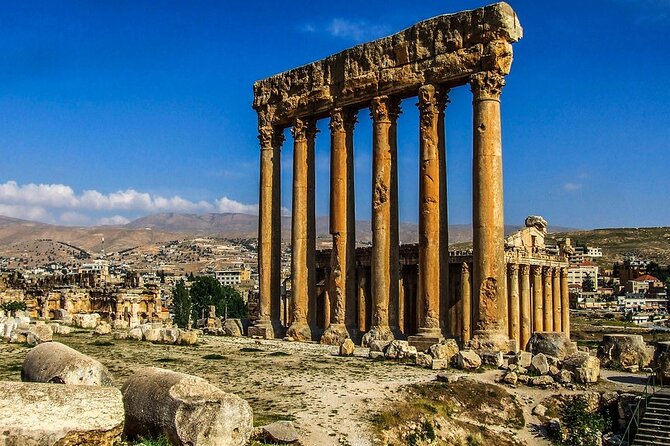
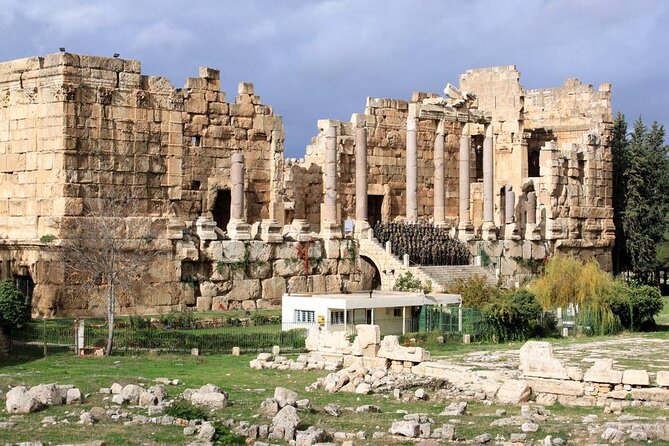
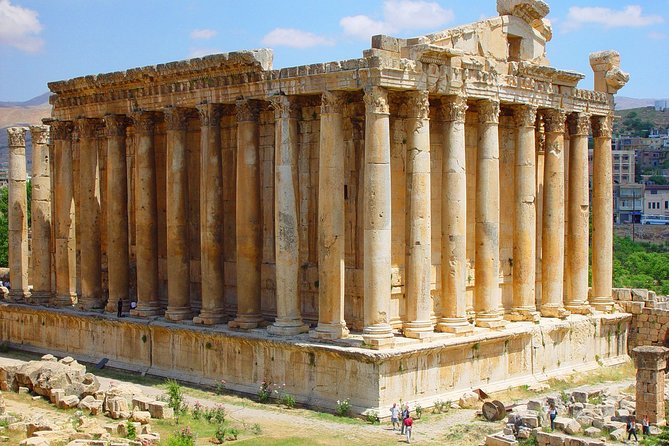
Baalbek is the heavyweight stop. Set in Lebanon’s Beqaa Valley, the site contains the temples of Jupiter, Bacchus, and Venus. The scale is immediately impressive, even if you know little about Roman architecture.
The planned visit lasts about 1 hour and 30 minutes. That is the longest scheduled stop, and it should be. Baalbek is not a single ruin that you can understand in a few minutes. It is a large complex with columns, platforms, courtyards, carved stone, and the remains of buildings devoted to Roman gods.
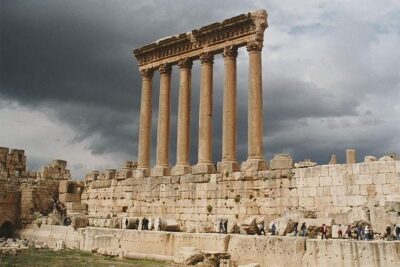
The Temple of Jupiter is associated with some of the biggest columns in the Roman world. The Temple of Bacchus is especially notable for its detailed decoration and surviving structure. The Temple of Venus has a different form and adds variety to the complex rather than simply repeating the same design.
Your local Baalbek guide is an important part of the visit. Ruins of this size can become a blur of stone unless someone explains what you are seeing. The one detailed rating of this tour gives special credit to Paula, who was praised for her explanations and for making sure the group had a good experience. That is exactly the kind of guidance Baalbek needs.
The ticket is not included, so confirm the current entrance cost before the day begins. The tour price covers the guide and transportation, but not this admission. Carrying some local currency or another accepted payment method may be sensible, though the available information does not specify payment options.
Baalbek also requires patience with scale. You may spend as much time looking at engineering details as at statues or carvings. Massive stones, tall columns, and finely cut reliefs show how much labor and planning went into the complex.
This is not a quick photo stop. If you enjoy ancient sites, you will probably wish for even longer than 90 minutes. The private format may help because you can ask questions directly, but the overall eight-hour limit still puts a boundary on the visit.
The Stone of the Pregnant Woman
The Stone of the Pregnant Woman is a short stop near Baalbek. It is a worked Roman monolith, one of the largest stones ever quarried, and another enormous block lies nearby.
The name is memorable, but the engineering question is even more interesting: how did ancient builders quarry, move, and intend to use stones of this size? The blocks were apparently meant for the nearby Roman temple complex, though they were never placed there.
You get about 15 minutes at the site, and no admission fee is listed. That is enough to see the stone, understand its connection to Baalbek, and take photographs. It is not a separate archaeological complex requiring a long visit.
I appreciate this stop because it makes the temple ruins easier to understand. At Baalbek, you see the finished columns and walls. Here, you see the raw material and the extreme ambition behind the construction project.
What the transportation and schedule mean
The tour lasts about eight hours, with pickup and drop-off at your hotel in Beirut. The vehicle is described as comfortable and air-conditioned, a useful feature for a full day that combines city pickup, mountain roads, and the Beqaa Valley.
The private format is the biggest logistical advantage. You do not share the outing with unrelated groups, and only your party participates. That usually makes it easier to keep the day organized and to ask the guide for clarification.
Still, this is a long route with several major stops. The listed times add up to about 2 hours and 45 minutes for Bcharre, the cedars, Baalbek, and the Stone of the Pregnant Woman, leaving the rest of the day for driving, the general Qadisha Valley visit, and transitions.
That schedule explains both the appeal and the limitation. You can see a lot in one day, but you will not have unlimited time at any one place. If your priority is a thorough Qadisha hike, a long visit in Bcharre, or a detailed archaeological study of Baalbek, you may prefer separate day trips.
Lunch is not included. Since the day involves substantial driving and several stops, ask your tour leader how and when a meal break will fit into the schedule. The tour information does not name a restaurant or provide a menu, so do not assume a specific lunch arrangement.
Who should choose this tour?
I would recommend this outing to you if you are staying in Beirut and want to see Lebanon’s northern mountains and Baalbek without arranging several transport connections. It is especially useful for a first visit when you want a broad introduction rather than a slow, specialist visit to one site.
It suits couples, families, and small private groups who value convenience. It also works well for anyone who prefers having a tour leader on the road and a dedicated local guide at Baalbek.
You should think twice if you dislike long driving days or prefer unhurried sightseeing. The Qadisha Valley and Baalbek both reward time, while the schedule gives each only a limited window. The 30-minute cedar visit is enough for a taste, not for a full nature outing.
The tour may also appeal to you if you have a particular interest in religious history, ancient engineering, Lebanese national symbols, or Khalil Gibran. Few short excursions connect all four subjects so clearly.
Is the $150 price good value?
At $150 per person, the value depends on your group size and priorities. The package includes private transportation, air conditioning, a tour leader, hotel pickup and drop-off, and a local Baalbek guide. Those inclusions cover the parts of the day that are hardest to arrange on your own.
The missing costs are lunch and the Baalbek admission ticket. That does not make the price unreasonable, but it means your final spending will be higher than the headline amount.
The strongest value comes from the range of places covered. You are not paying for a single attraction. You are paying for a full day of transport between Beirut, the Qadisha area, and Baalbek, with interpretation at the most important archaeological stop.
Because the tour is private, the price may be more appealing for a small group sharing the convenience. Solo visitors should compare it with other transport options before booking. The available rating is excellent, but only one written rating is provided, so I would treat Paula’s praise as a positive signal rather than proof that every departure will be identical.
Free cancellation is available if you cancel at least 24 hours before the start time. Changes or cancellations made less than 24 hours before departure are not accepted for a refund.
Should you book it?
Book this tour if you want a wide-ranging Lebanon day trip with private transport and a guide, and if you accept that each location will receive a brisk visit. The combination of Qadisha Valley, the Cedars of God, Bcharre, and Baalbek is hard to match in one organized day.
I would be especially comfortable booking it for a small group that values pickup, air conditioning, and a private schedule. Paula’s praised guiding gives the Baalbek portion an encouraging personal detail.
Skip it if your main goal is extended hiking in Qadisha Valley or several leisurely hours among the Roman temples. For everyone else, this is a strong introduction to Lebanon’s mountains, sacred places, cedar heritage, and ancient architecture, provided you budget for lunch and the Baalbek ticket and prepare for a full day on the road.
FAQ
How long does the tour last?
The experience lasts approximately eight hours.
Is hotel pickup and drop-off included?
Yes. Hotel pickup and drop-off are included.
Is this a private tour?
Yes. Only your group participates in the activity.
Is transportation included?
Yes. The tour includes private transportation in a comfortable air-conditioned vehicle.
Is lunch included?
No. Lunch is not included in the tour price.
Is the Baalbek entrance ticket included?
No. The admission ticket for the Temples of Baalbek is not included.
Can I cancel for a full refund?
Yes, if you cancel at least 24 hours before the experience start time. Cancellations made less than 24 hours before the start time are not refunded.
Just added in Beirut
- RZR XP4 (4 Seat Buggy) Full Day Off-Road Scenic Adventures★ 5.0 · 2 reviews
- Sidon, Magdouche and Tyre★ 5.0 · 1 review
- Small-Group Tour to Beirut, Beiteddine and Deir El Qamar with Lunch and Tickets★ 5.0 · 1 review
- Full-Day Private Tour to Baalbek, Anjar And Ksara From Beirut★ 5.0 · 2 reviews
- Full-Day Private Tour to Beiteddine, Deir El Qamar, Mousa Palace★ 5.0 · 2 reviews
- Unlocking the Wonders of Lebanon: Journey Through Qadisha Valley★ 5.0 · 2 reviews
- Beirut to Beiteddine: Private Journey Through Palaces & Villages★ 4.5 · 2 reviews
- Private Tour – Hamatoura Monastery★ 5.0 · 1 review
Baalbek Anjar and Ksara Day Trips
Anjar, Baalbek & Ksara Day Trip – With Lunch (4G on Board)
Read our review →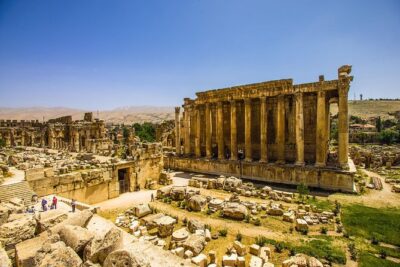
Private Anjar and Baalbek Tour from Beirut with Departure Ticket
Read our review →
Guided Private Full Day Tour to Baalbek, Anjar and Chateau Ksara
Read our review →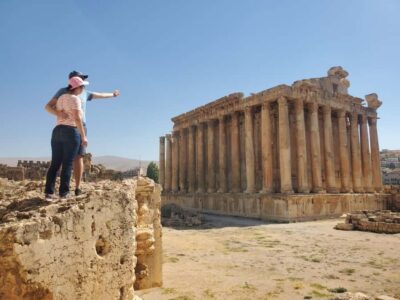
Baalbek Temples & Ksara Caves w/pick-up,guide, entries+lunch
Read our review →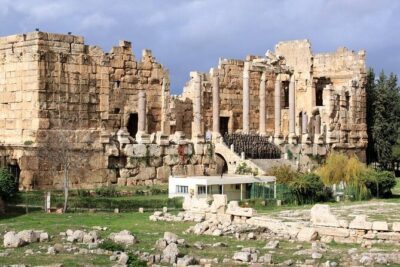
Small Group Tours to Baalbek, Anjar & Chateau Ksara with lunch and Tickets
Read our review →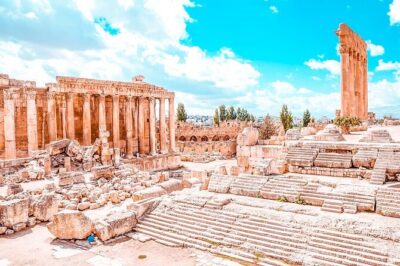
Private Tour: Anjar, Baalbek and Ksara Day Trip from Beirut
Read our review →