REVIEW · JEITA GROTTO AND HARISSA DAY TRIPS
Lebanon’s Triple Delight: Jeita Grotto, Baalbek & Chateau Ksara
Three Lebanese icons, one long day. This private tour links the cool caverns of Jeita Grotto, the massive Roman temples of Baalbek, and a wine tasting at Chateau Ksara, all with round-trip pickup from Beirut. I especially like the private vehicle, which removes the strain of arranging several long journeys, and the mix of nature, archaeology, and food culture. You get three very different sides of Lebanon in one outing.
The main caution is the pace. Nine hours is enough for the headline sights, but Jeita and Baalbek are far apart, and lunch is not included. Entrance fees at Jeita Grotto and Baalbek are also paid separately, so the $75 price is not the full cost of the day.
In This Review
- Key points at a glance
- Why this route works from Beirut
- Jeita Grotto: a cool beginning underground
- Baalbek’s Roman scale is the main event
- Sayyida Khawla Mosque and a sacred Baalbek stop
- The Stone of the Pregnant Woman and Roman engineering
- Chateau Ksara: Lebanon in a tasting glass
- What the $75 price really covers
- Timing, comfort, and the long-day tradeoff
- Who should book this Lebanese day tour?
- Should you book Lebanon’s Triple Delight?
- FAQ
- How long does the tour last?
- Is hotel pickup included?
- Is this a private tour?
- Is transportation included?
- Are entrance fees included?
- Is the Chateau Ksara wine tasting included?
- Is lunch included?
- Can I cancel for a full refund?
Key points at a glance
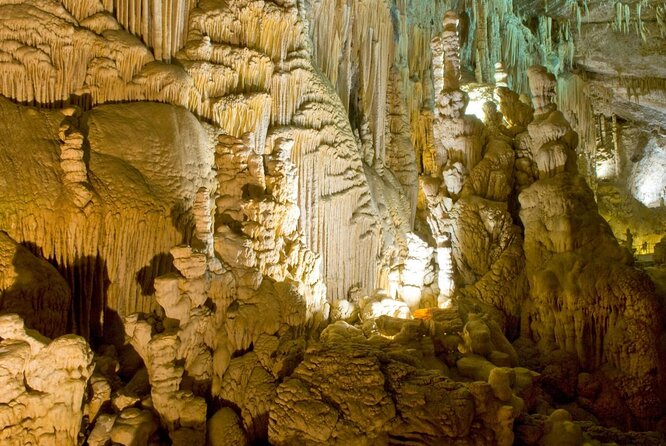
- Jeita has two cave levels: The upper gallery is filled with formations, while the lower gallery includes an underground river and lake.
- Baalbek is the day’s heavyweight: Its Roman temples were built over more than two centuries and remain among the great ancient sanctuaries.
- Chateau Ksara adds a Lebanese flavor: The winery was founded by Jesuit priests in 1857 and produces about three million bottles each year.
- The route is private: Only your group takes part, with hotel pickup, drop-off, and air-conditioned transport.
- The schedule runs about nine hours: The main stops are Jeita for 90 minutes, Baalbek for 90 minutes, the Stone of the Pregnant Woman for 15 minutes, and Chateau Ksara for one hour.
- Budget for extras: Lunch and admission to Jeita Grotto and Baalbek are not included, while the Chateau Ksara tasting is included.
Why this route works from Beirut
Lebanon packs a surprising amount into a small area, but the sights on this tour are not next door to one another. Jeita Grotto lies north of Beirut, while Baalbek and Chateau Ksara are in the Beqaa Valley. Doing them independently means sorting out transport, timing, and local access. Here, the driver handles the long connections while you watch the country change outside the window.
I like the private format for another reason: it gives your group a little breathing room. This is not a large coach outing with dozens of people moving as one block. The tour is private, and a local guide joins you at Baalbek, where good explanation makes a real difference among the huge columns and fallen stones.
The advertised start is 8:00 am, and the full outing lasts about nine hours. That makes it a full day, not a quick city add-on. Still, the route is efficient. You see a cave system, a Roman sanctuary, a monumental quarry stone, a Shiite religious site, and one of Lebanon’s best-known wineries without changing hotels or arranging separate rides.
More Jeita and Harissa day trips:
- Guided Small-Group Tour to Jeita, Harissa, Byblos with Lunch
★ 5.0 · 361 reviews - Jeita Grotto,Harissa&Byblos Full-Day PRIVATE-CAR Trip from Beirut
★ 5.0 · 222 reviews - Jeita Grotto – Harissa – Byblos Trip
★ 5.0 · 169 reviews
Jeita Grotto: a cool beginning underground
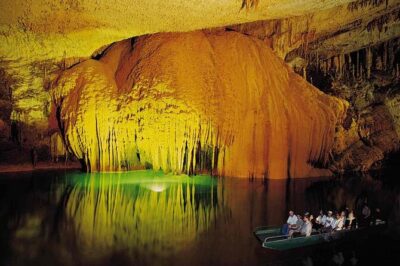
Jeita Grotto is the most unusual stop on the route. It is a system of two connected limestone caves formed over millions of years, with a total complex length that makes it the longest cave system in the Middle East. The site sits about 300 meters above sea level, with a height difference of 305 meters between its levels.
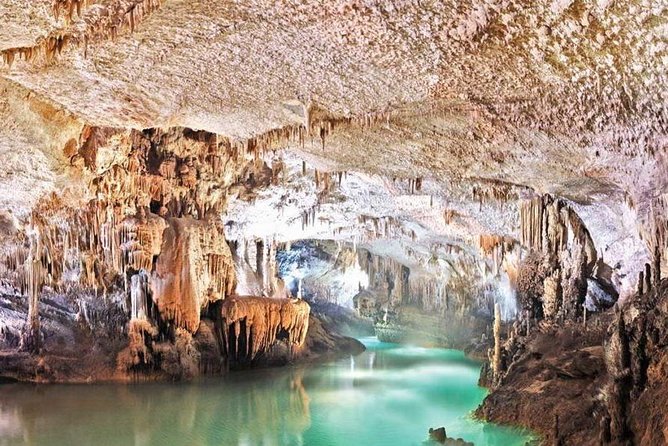
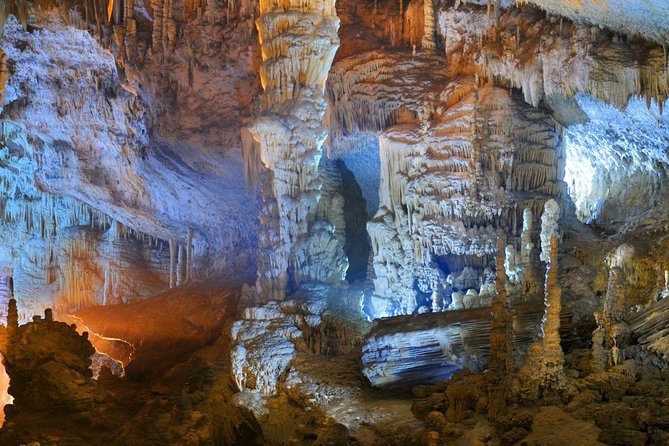
The upper cave is the more sculptural part of the visit. It extends about 2,130 meters and contains stalactites, stalagmites, columns, mushrooms, ponds, curtains, and draperies. These names can sound like a standard cave checklist, but the point is variety. The formations change shape and texture as you move through the cavern, giving the upper gallery a fairy-tale feel without needing much decoration from a guidebook.
The lower gallery is much longer, at about 6,200 meters, and sits 60 meters below the upper level. It is crossed by a smooth underground river and a lake. That combination of water and stone gives Jeita its character. You are not just looking at dry rock. The cave has a living, flowing element beneath the mineral formations.
The scheduled visit is 1 hour and 30 minutes. That is a useful amount of time for a first look, though you should not expect an exhaustive exploration of every passage. Admission is not included, so keep that extra cost in mind before booking.
Jeita is also a good first stop because it offers a change of temperature and mood from Beirut. After the pickup and drive, the cool interior gives you a physical break from the day. Wear practical shoes and expect some walking, since the attraction includes two cave levels and different types of viewing areas. The supplied details do not specify every transport arrangement within the site, so follow the local instructions when you arrive.
Baalbek’s Roman scale is the main event
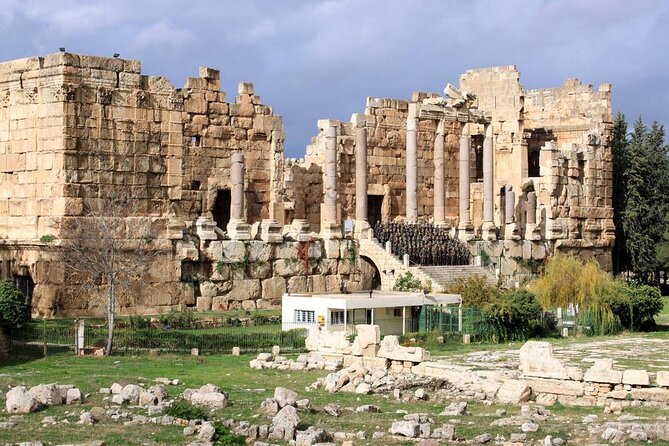
If Jeita is the most unusual stop, Baalbek is the most powerful. The temple complex lies at the foot of the Anti-Lebanon range, beside the fertile Beqaa Valley, at an altitude of about 1,150 meters. The setting matters. After the cave, you move into open space and ancient stonework on a vast scale.
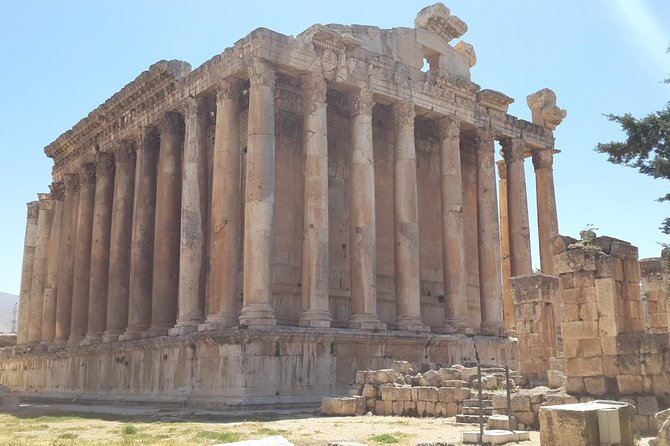
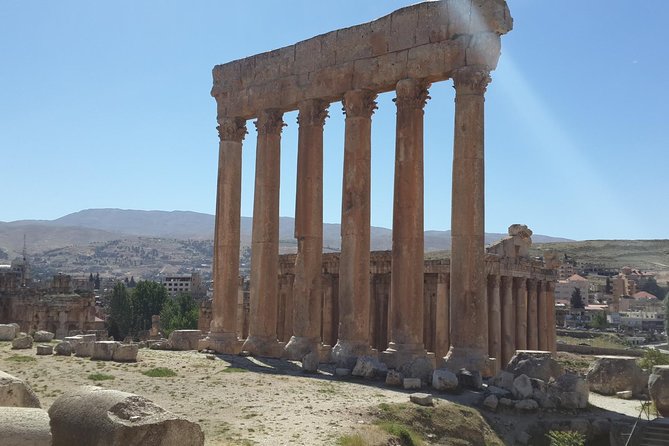
Baalbek reached its peak during the Roman period. Construction of its colossal buildings continued for more than two centuries, creating one of the most famous sanctuaries in the Roman world. The complex was dedicated to a Romanized version of the Heliopolis triad: Jupiter, Venus, and Bacchus. Beneath those Roman names was an older Phoenician religious tradition.
That layered story is what makes the site more than a pile of old columns. You are seeing Roman imperial architecture built over and alongside an older local cult. The remains show how Rome used monumental building to express power, while also adopting and reshaping established religious traditions.
Your visit here lasts about 1 hour and 30 minutes, with a local guide included. I consider that guide an important part of the price. Baalbek is so large that it can be hard to understand without help. A row of columns, a platform, or a fallen block becomes more meaningful when you know what role it had in the sanctuary and how the complex developed.
One available account praised the guide as fantastic and said the sightseeing time felt generous. That matches the design of this outing: you are not simply driven to Baalbek, given a quick photograph stop, and hurried away. The planned 90 minutes gives you time to look, listen, and take in the scale.
Admission to the temples is not included. This is one of the tour’s most important budgeting details. The $75 covers the private transport and guiding services listed, but you should expect to pay the Baalbek entrance fee yourself.
Sayyida Khawla Mosque and a sacred Baalbek stop
The route also includes the Mosque of Sayyida Khawla in Baalbek. It is built at the site where Sayyida Khawla, the daughter of Imam al-Hussein and granddaughter of the Prophet Muhammad, is believed to have been buried.
People in Baalbek connect the site with the caravan of captives from Karbala, during which Khawla is believed to have died and been buried there. This stop adds a present-day religious dimension to a day otherwise dominated by ancient Roman remains.
The supplied schedule does not give a separate visit length or detailed access rules for the mosque. Treat it as a respectful cultural stop rather than assuming a long guided tour. Dress and behave appropriately at a religious site, and follow any local instructions given by the tour leader.
I like this addition because it keeps Baalbek from being presented only through Roman history. The town has a living religious identity, and this stop gives you a glimpse of it.
More Baalbek and Bekaa day trips:
- Guided Small-Group Tour to Baalbek, Anjar and Ksara with Lunch
★ 5.0 · 511 reviews - Anjar, Baalbek & Ksara Day Trip – With Lunch (4G on Board)
★ 4.5 · 181 reviews - Baalbek – Anjar – Ksara Trip From Beirut
★ 4.5 · 80 reviews - Private Anjar and Baalbek Tour from Beirut with Departure Ticket
★ 5.0 · 79 reviews
The Stone of the Pregnant Woman and Roman engineering
The Stone of the Pregnant Woman is a short stop, only about 15 minutes, but it makes a strong visual point. It is a worked Roman monolith near Baalbek, one of two enormous blocks believed to have been intended for the nearby temple complex.
These stones reflect the extreme scale of Roman building at Baalbek. The monolithic blocks were so large that their construction and intended use still capture the imagination. You do not need a long visit to understand the basic message: the builders were working with ambition that bordered on the absurd.
Admission here is free, so the stop adds interest without another ticket. Because the visit lasts only 15 minutes, use it for a close look and photographs rather than expecting a full archaeological explanation. Its value comes from seeing the raw material that helps explain how the temple complex could reach such monumental proportions.
Chateau Ksara: Lebanon in a tasting glass
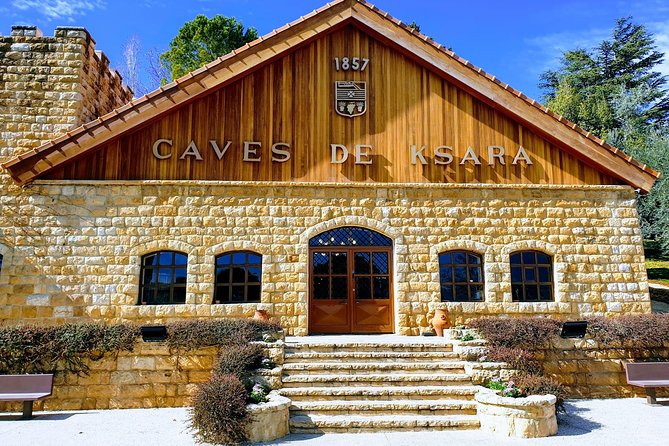
After caves and temples, Chateau Ksara changes the pace. The winery was founded by Jesuit priests in 1857 and developed the first dry wine in Lebanon. Today it produces about three million bottles each year, with exports to more than 40 countries.
The one-hour visit includes a wine tasting, which is a welcome inclusion in a tour where two major entrance fees are extra. It gives you a chance to experience Lebanon through its agricultural and culinary traditions rather than only through monuments.
I would not treat this as a full winery study unless the local program provides more detail on the day. The confirmed feature is a tasting at Chateau Ksara, with one hour allocated to the stop. That is enough for a pleasant introduction, but not necessarily enough for a long technical tour of production.
The winery is in the Beqaa Valley, so it fits naturally into the Baalbek portion of the route. It also gives the day a social finish. After the solemnity of a religious site and the weight of ancient stone, a tasting offers a lighter final chapter.
The wine tasting is included, but lunch is not. If you need a proper meal during the nine-hour outing, plan for that expense and ask the tour provider how the day’s timing handles it. The information supplied does not specify a restaurant or a fixed lunch stop, so do not assume one is part of the package.
What the $75 price really covers
At $75 per person, this tour offers solid value if you want a private day outside Beirut without arranging each piece yourself. The listed inclusions cover hotel pickup and drop-off, comfortable private transportation, an air-conditioned vehicle, a tour leader, a local guide in Baalbek, and the Chateau Ksara tasting.
The private ride is the biggest value point. These are not three easy stops to connect by public transport in a single day. You are paying for a driver and a planned route, not just entry to attractions. For a couple or small group, the convenience can be worth more than chasing the lowest possible transport fare.
Still, calculate the real budget before you book. You must pay admission at Jeita Grotto and Baalbek, and lunch is extra. Group discounts may be available, which could improve the per-person value for a larger party. A mobile ticket is offered, and confirmation is received at booking.
The tour earns its price best when you value time and simplicity. If you already have a car, know the roads, and prefer to set your own pace, you might find the fixed schedule less appealing. If you want three major sights in one day with minimal planning, the arrangement is much more attractive.
Timing, comfort, and the long-day tradeoff
The day begins at 8:00 am and lasts approximately nine hours. That means an early start and a full schedule, but the itinerary does not feel overloaded with minor attractions. Each main stop has a clear purpose.
Jeita receives 90 minutes, Baalbek receives 90 minutes, the Stone of the Pregnant Woman receives 15 minutes, and Chateau Ksara receives one hour. The mosque stop has no separate duration stated. Travel between these places fills the rest of the day, which is why private transport matters.
The air-conditioned vehicle should make the road portions more comfortable, especially when you are carrying the physical and mental load of several major stops. Door-to-door pickup and drop-off also save you from beginning and ending the day with a taxi search.
The tradeoff is flexibility. A private tour may let your group communicate preferences, but the published structure still has a set route and approximate times. You should not expect to linger at every location indefinitely. The day works best if you enjoy a purposeful itinerary and are willing to keep moving.
Who should book this Lebanese day tour?
I would recommend it to first-time visitors based in Beirut who want to see beyond the capital without spending several days organizing transport. It also suits couples, families, and small private groups that value a vehicle of their own.
History lovers will appreciate Baalbek, especially with a local guide. Nature fans will find Jeita the most memorable stop. Wine drinkers will enjoy ending at Chateau Ksara, while anyone interested in Lebanon’s religious life will gain something from the Sayyida Khawla Mosque stop.
I would think twice if you dislike full-day outings, need a slow lunch, or want long independent visits at every site. The tour is broad by design. It gives you a strong first look at several places, not a deep, leisurely stay in one town.
You can cancel for a full refund if you do so at least 24 hours before the 8:00 am start time. Cancellations or changes made within 24 hours are not refunded or accepted, and the cut-off follows local time.
Should you book Lebanon’s Triple Delight?
Book this tour if you want an efficient private route from Beirut that combines Lebanon’s most dramatic cave, its greatest Roman ruins, and a respected local winery. The guide at Baalbek, air-conditioned transport, and included wine tasting add real value.
Before paying, confirm the current entrance fees and think through lunch. With those extras included in your budget, the $75 price is fair for a private nine-hour outing. I would choose it for convenience, variety, and the chance to see Baalbek without having to manage the road connections yourself.
FAQ
How long does the tour last?
The tour lasts approximately nine hours, beginning at 8:00 am.
Is hotel pickup included?
Yes. Hotel pickup and drop-off are included.
Is this a private tour?
Yes. Only your group participates in the activity.
Is transportation included?
Yes. The tour includes comfortable private transportation in an air-conditioned vehicle.
Are entrance fees included?
Admission to Jeita Grotto and the Baalbek temples is not included. You pay those fees separately. Admission to the Stone of the Pregnant Woman is free.
Is the Chateau Ksara wine tasting included?
Yes. The Chateau Ksara tasting is included in the tour.
Is lunch included?
No. Lunch is not included.
Can I cancel for a full refund?
Yes, if you cancel at least 24 hours before the experience start time. Cancellations within 24 hours are not refunded, and changes within that period are not accepted.
Just added in Beirut
- Small-Group Tour to Beirut, Beiteddine and Deir El Qamar with Lunch and Tickets★ 5.0 · 1 review
- RZR XP4 (4 Seat Buggy) Full Day Off-Road Scenic Adventures★ 5.0 · 2 reviews
- Sidon, Magdouche and Tyre★ 5.0 · 1 review
- Full-Day Private Tour to Baalbek, Anjar And Ksara From Beirut★ 5.0 · 2 reviews
- Full-Day Private Tour to Beiteddine, Deir El Qamar, Mousa Palace★ 5.0 · 2 reviews
- Exploring the Qadisha Valley, Cedars of God, and Baalbek Temples★ 5.0 · 1 review
- Unlocking the Wonders of Lebanon: Journey Through Qadisha Valley★ 5.0 · 2 reviews
- Beirut to Beiteddine: Private Journey Through Palaces & Villages★ 4.5 · 2 reviews
Jeita Grotto and Harissa Day Trips
Guided Small-Group Tour to Jeita, Harissa, Byblos with Lunch
Read our review →
Jeita Grotto,Harissa&Byblos Full-Day PRIVATE-CAR Trip from Beirut
Read our review →
Byblos, Jeita Grotto & Harissa Day Trip -With Lunch (4G on Board)
Read our review →
Semi-Private Tour to Jeita Grotto, Harissa & Byblos with Lunch
Read our review →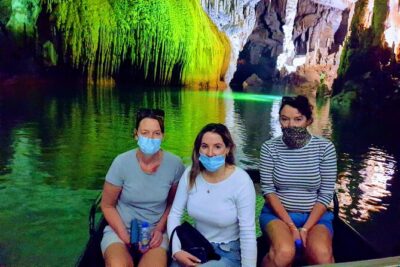
Private Guided Tour to Jeita Grotto through Harissa and Byblos
Read our review →
New Guided Semi-Private Tour to Jeita Grotto, Harissa & Byblos
Read our review →