REVIEW · JEITA GROTTO AND HARISSA DAY TRIPS
Guided Full-Day Private Tour to Jeita Grotto, Byblos and Baalbek
Three Lebanese icons, one very long day. This private tour links the crystal formations of Jeita Grotto with the ancient port of Byblos and the huge Roman temples of Baalbek. I like the front-door pickup and private, air-conditioned vehicle, and I like how one guide connects Lebanon’s Phoenician, Roman, and modern stories. The main drawback is simple: ten hours on the road leaves little room for a relaxed lunch or long wandering, and entrance fees are not included.
The $100 per person price makes the most sense if you have limited time in Beirut or want your own group rather than a large coach. You start at 7:30 am, visit three major sites, and return after a full day of sightseeing. Hassan is the named guide praised for making the day fun and easy to follow, so it is worth asking if he is available when you book.
In This Review
- Key Points at a Glance
- Why This Full-Day Route Works
- Starting at Jeita Grotto
- Walking Through Byblos and Its Phoenician Past
- Climbing Byblos Castle
- The Old Souk and Ancient Port
- Entering Baalbek’s Roman World
- The Stone of the Pregnant Woman
- What the Private Vehicle Adds
- Is $100 Per Person Good Value?
- Who Should Book This Day?
- Final Verdict: Book It for Breadth and Ease
- FAQ
- How long is the tour?
- What time does the tour start?
- Is hotel pickup included?
- Is transportation private?
- Is the vehicle air-conditioned?
- Is lunch included?
- Are entrance fees included?
- How long is the Jeita Grotto visit?
- How much time is allowed in Byblos?
- How much time is allowed at Baalbek?
- Can I cancel for a full refund?
Key Points at a Glance
- Three major sights in one day: See Jeita Grotto, Byblos, and Baalbek without arranging separate transport.
- Private from pickup to drop-off: Only your group takes part, with hotel pickup and return in an air-conditioned vehicle.
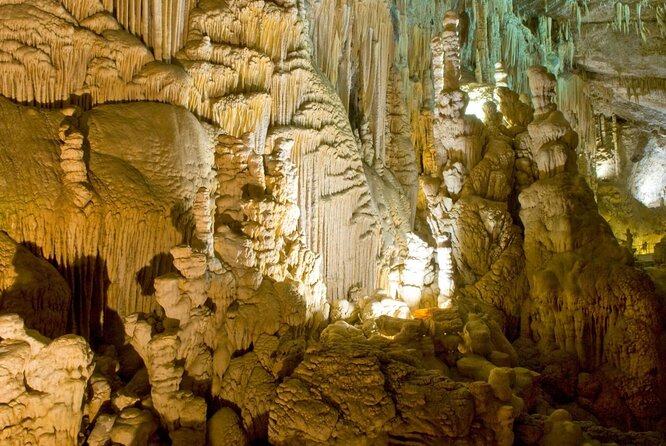
- Jeita has two cave levels: The upper gallery is filled with formations, while the lower gallery follows an underground river and lake.
- Byblos packs history into a small area: Castle ruins, ancient temples, the old souk, and the port are all included.
- Baalbek is the grand finale: The Roman temples of Jupiter and Bacchus are among Lebanon’s biggest sights.
- Budget for extras: Jeita Grotto and the main ticketed areas at Byblos Castle and Baalbek are not included, and lunch is also on your own.
Why This Full-Day Route Works
Lebanon rewards visitors who can connect several periods of history in one trip. Jeita is a natural wonder formed over millions of years. Byblos reaches back to Neolithic settlement and Phoenician trade. Baalbek then shifts the story to the grand Roman world of Heliopolis.
I like that the route is not built around one kind of sightseeing. You get caves, a seaside archaeological city, a Crusader castle, a market street, an ancient harbor, and colossal temples. That variety keeps the day moving, even though the schedule is demanding.
The private format is important here. You do not have to wait for a large group at each stop, and your guide can explain the sites at a pace that suits your group. Door-to-door transport also removes the work of finding separate rides between Beirut, the coast, and the Bekaa Valley.
Still, this is a greatest-hits day, not a slow cultural visit. The listed stops add up to several hours, and the driving between regions takes time. You should book it to see the major sights efficiently, not to linger over every inscription or spend an afternoon beside the port.
More Jeita and Harissa day trips:
- Guided Small-Group Tour to Jeita, Harissa, Byblos with Lunch
★ 5.0 · 361 reviews - Jeita Grotto,Harissa&Byblos Full-Day PRIVATE-CAR Trip from Beirut
★ 5.0 · 222 reviews - Jeita Grotto – Harissa – Byblos Trip
★ 5.0 · 169 reviews
Starting at Jeita Grotto
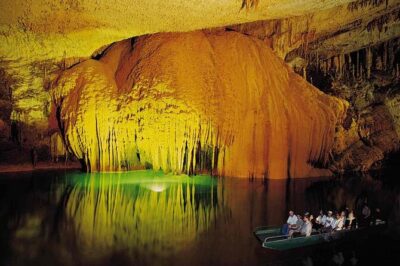
The day begins at Jeita Grotto, about 300 metres above sea level. This is a two-part karstic limestone cave system formed over millions of years, with a total length that makes it the longest cave complex in the Middle East.
The upper cave is the visual showpiece. Its passage extends for about 2,130 metres and contains stalactites, stalagmites, columns, mushrooms, ponds, curtains, and draperies. The names sound technical, but the practical point is easier: you are looking at a wide range of mineral shapes, not one repetitive tunnel.
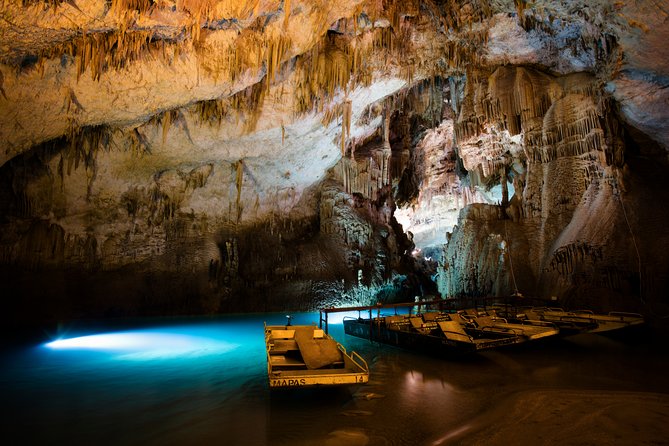
The lower gallery lies 60 metres below the upper one. It extends about 6,200 metres and includes a smooth underground river and a lake. The two galleries are separate but connected parts of the same cave system, giving the visit two different moods.
You have about one hour here. That is enough for a focused visit, but not enough to treat the cave as a leisurely half-day outing. Admission is not included, so check the current fee before departure and keep extra money available.
Jeita is a strong first stop because it gives the day an immediate sense of place. You are not simply looking at old stones. You are seeing a natural formation whose scale and age set a useful frame for the human history that follows.
Walking Through Byblos and Its Phoenician Past
After Jeita, the tour heads to Byblos, one of the oldest Phoenician cities. It has been inhabited since Neolithic times and is closely tied to Mediterranean legend, trade, and the spread of the Phoenician alphabet.
The main Byblos visit lasts about an hour, followed by separate stops at the castle, souk, and port. This division is useful because Byblos works best on foot. You can shift from archaeological ruins to old streets and then to the waterfront without needing another vehicle between each point.
Your guide’s explanations matter here. Without context, a collection of foundations can blur together. With a clear account of Phoenician trade, the ancient port, and the alphabet’s importance, the site becomes easier to read.
The schedule is brisk. You have enough time to get a feel for the town, but not necessarily enough to examine every ruin in detail. If you are especially interested in archaeology, ask your guide which parts deserve your attention before you begin.
Climbing Byblos Castle
Byblos Castle is a restored 12th-century Crusader fortress just inside the archaeological area. A dry moat about 10 metres wide surrounds it, giving the building a strong defensive profile even before you enter.
The square keep is the best reason to visit. From the top, you get a broad view over the archaeological ruins, including the remains of the Temple of Baalat Gebal and the Temple of the Obelisks. Bronze Age dwellings can be seen below the castle walls in the direction of the sea.
Inside, a small museum and information panels outline the city’s past. These displays give you a useful pause from the open-air ruins. They also help explain how many different periods occupy the same compact area.
You have about 30 minutes at the castle, and admission is not included. That is enough for the main viewpoint and a quick look inside, but the time may feel short if you want to read every panel.
I would treat the castle as the visual center of Byblos. The ruins explain the city’s age, but the keep gives you the clearest sense of how the ancient port, later settlement, and sea fit together.
More of Byblos:
- Byblos, Jeita Grotto & Harissa Day Trip -With Lunch (4G on Board)
★ 4.5 · 145 reviews - Semi-Private Tour to Jeita Grotto, Harissa & Byblos with Lunch
★ 5.0 · 52 reviews - Small Group Tour to Jeita Grotto, Harisa & Byblos with Hotel pickup
★ 5.0 · 49 reviews - Private Guided Tour to Jeita Grotto through Harissa and Byblos
★ 5.0 · 48 reviews
The Old Souk and Ancient Port
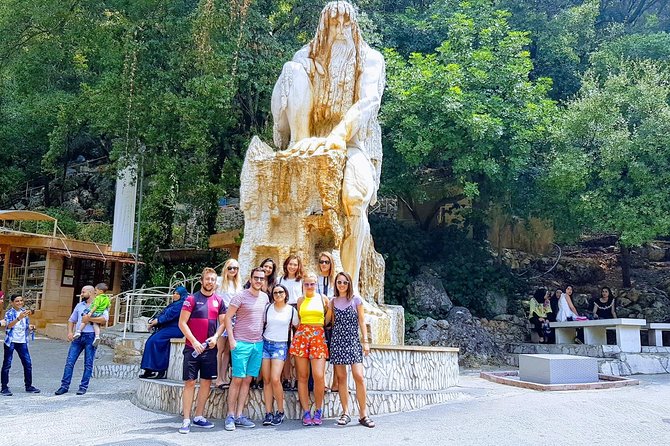
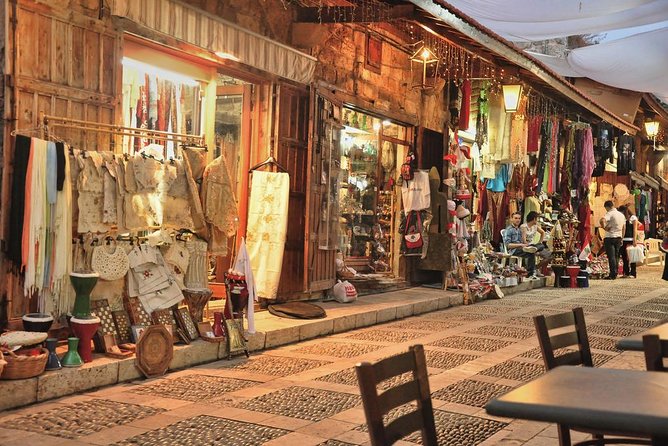
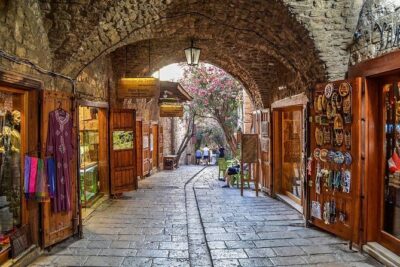
The old souk gets about ten minutes. That sounds brief, and it is. You can stroll along the cobblestone streets, look at the architecture, and browse for souvenirs or antiques, but this is not a serious shopping stop.
The short visit still adds something. It breaks up the archaeological sightseeing with a living street scene, and you get a quick look at how Byblos functions beyond its ruins. If you see something worth buying, do not assume there will be time to return later.
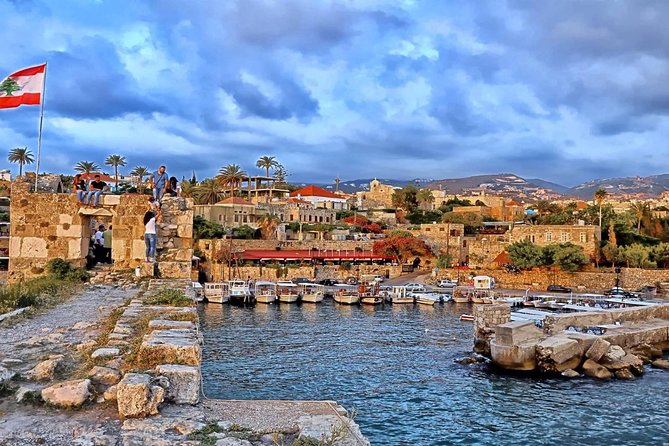
The port also gets about ten minutes. Byblos Port is traditionally regarded by Lebanese people as the oldest port in the world, and around 3000 BC it was a major timber-shipping center in the eastern Mediterranean.
The port stop is more about atmosphere and historical meaning than a long activity. I would listen closely to the explanation here. The harbor helps you understand why Byblos became important in the first place: its story is tied to maritime trade, timber, and contact across the Mediterranean.
Both stops have free admission, according to the tour details. Their short duration also shows the overall style of this day. You are collecting clear impressions of several places rather than spending hours in one town.
Entering Baalbek’s Roman World
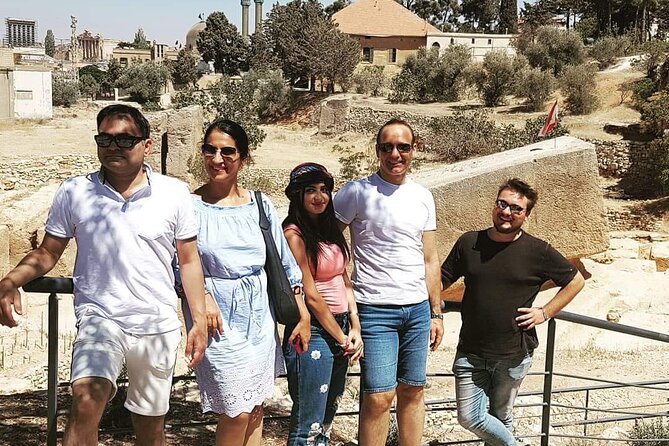
Baalbek is the largest historical stop and the day’s most dramatic change of scale. The city lies in the Bekaa Valley at the foot of the Anti-Lebanon range, at an altitude of about 1,150 metres.
The site was known as Heliopolis during the Hellenistic period. In Roman times, it remained a major religious center dedicated to the Heliopolitan triad, identified with Jupiter, Venus, and Bacchus. Pilgrims came here to worship, and Roman builders created a sanctuary on a huge scale.
The Baalbek visit is listed at about one hour and 30 minutes, with another 90 minutes for the temples. That gives you more time than the Byblos stops, and it needs it. The complex is large, and the structures are so massive that you need a little time simply to grasp their size.
The Temple of Bacchus is one of the main highlights. It is one of the largest and best-preserved Roman temple ruins in the complex, with a level of detail that rewards a close look.
The Temple of Jupiter gives you the other side of Baalbek’s story: enormous Imperial Roman construction. The site’s scale is hard to understand from photographs. Your guide can help identify how the temple complex was arranged and how the Phoenician religious tradition continued under Roman rule.
Baalbek became a UNESCO World Heritage site in 1984. That designation matters less as a label than as a reminder of the site’s importance. This is one of the finest surviving examples of Imperial Roman architecture at its height, built over more than two centuries.
Admission to the temple area is not included. Confirm the current ticket arrangements before the tour begins, since this is one of the main extra costs beyond the $100 tour price.
The Stone of the Pregnant Woman
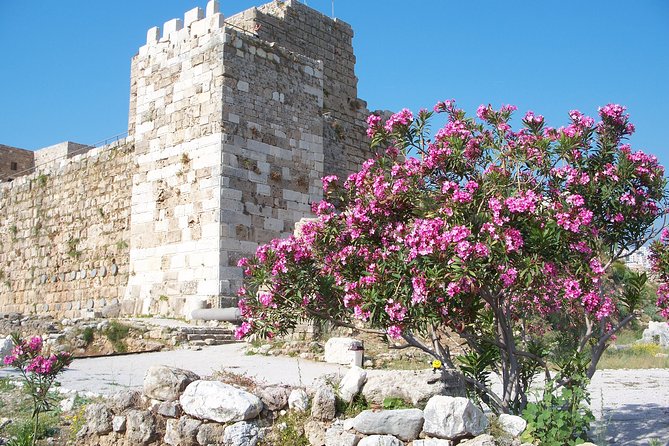
The final stop is the Stone of the Pregnant Woman, a worked Roman monolith near the Baalbek temple complex. It is one of a pair of enormous ancient blocks that rank among the largest stones ever quarried.
The block was likely intended for use in the nearby Roman temples. Its size shows the engineering ambition behind Baalbek, even though it never reached the sanctuary. The nickname adds a touch of local character to what is otherwise a remarkable building stone.
You get about 30 minutes here, and admission is free. That is plenty of time to see the stone, hear its connection to the temple project, and consider the practical challenge of moving such a block.
It is a fitting last stop. After seeing finished Roman temples, you see the raw material and the scale of the work behind them.
What the Private Vehicle Adds
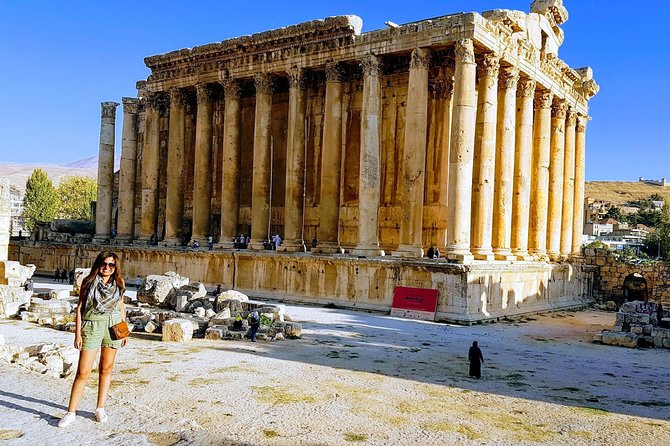
The tour includes hotel pickup and drop-off in Beirut, private transportation, and an air-conditioned vehicle. The 7:30 am start is early, but it is necessary for a route that crosses several parts of Lebanon in one day.
I see the transport as one of the tour’s strongest benefits. You do not have to arrange separate connections to Jeita, Byblos, and Baalbek, and you can return to the same vehicle between stops. For a short stay in Beirut, that convenience has real value.
The private setting also makes the day more adaptable than a fixed large-group outing. Only your party participates, so questions and explanations can stay relevant to your interests. The tour includes a tour leader and professional guides, with a focus on local experiences.
Do not confuse private with slow. Your group controls the company, but the route still has a fixed rhythm. The sites are spread across the country, and the schedule has to keep moving to reach Baalbek and return to Beirut within roughly ten hours.
Is $100 Per Person Good Value?
At $100 per person, this is not the cheapest possible way to see one Lebanese attraction. It becomes more convincing when you count what is included: hotel pickup and drop-off, private transport, an air-conditioned vehicle, and a guide for a full day.
You are also combining three major destinations that would be difficult to arrange smoothly without transport. If you have only a short time in Lebanon, the ability to cover Jeita, Byblos, and Baalbek in one booking can justify the price.
The cost is less attractive if you are traveling alone and prefer to explore slowly. You also need to add lunch and admission fees for Jeita, Byblos Castle, and the Baalbek temple area. Group discounts may improve the per-person value for a larger party, but the exact discount is not provided.
I would compare the price with the cost and effort of arranging a private vehicle, driver, and guide for ten hours. For a small group that wants a simple, door-to-door day, the package offers solid practical value. For a solo visitor focused on one site, it may feel excessive.
Who Should Book This Day?
I would recommend this tour to you if you are staying in Beirut and have only one free day for major sightseeing. It is also a good fit if you value private transport, want a guide’s historical explanations, or prefer not to plan several long transfers yourself.
The route suits first-time visitors who want a broad introduction to Lebanon. You see natural scenery underground, a Phoenician port city, Crusader architecture, and Roman temples in one sweep.
It is less suited to you if your priority is shopping in Byblos, detailed archaeological study, or a relaxed meal. The old souk and port stops are short, and lunch is not included. You should also be comfortable with an early start and a full ten-hour day.
The experience has a perfect 5 rating from five submitted reviews, with particular praise for Hassan and for the fun of covering all three must-see locations in one day. That is a small sample, so I would treat it as encouraging rather than conclusive. Still, it points to the tour’s central strength: an energetic guide and a well-packed route can make a demanding day feel rewarding.
Final Verdict: Book It for Breadth and Ease
Book this private tour if you want Lebanon’s biggest highlights without spending days arranging transport. Jeita Grotto, Byblos, and Baalbek each offer something different, and the guide helps connect those pieces into one readable story.
Skip it if you want long, unhurried visits or if you have enough time to explore each place separately. Before paying, confirm the guide, ask about the current entrance fees, and plan how you will handle lunch. If Hassan is available, his praised style may add extra warmth to an already strong route.
Cancellation is free up to 24 hours before the 7:30 am start for a full refund. Within 24 hours, cancellations and changes are not accepted for a refund.
FAQ
How long is the tour?
The tour lasts approximately 10 hours.
What time does the tour start?
The stated start time is 7:30 am.
Is hotel pickup included?
Yes. Hotel pickup and drop-off in Beirut are included.
Is transportation private?
Yes. The tour uses comfortable private transportation, and only your group participates.
Is the vehicle air-conditioned?
Yes. An air-conditioned vehicle is included.
Is lunch included?
No. Lunch is not included in the tour price.
Are entrance fees included?
No. Admission to Jeita Grotto, Byblos Castle, and the Baalbek temple area is not included. The main Byblos, old souk, port, and Stone of the Pregnant Woman stops are listed as free.
How long is the Jeita Grotto visit?
The scheduled visit to Jeita Grotto is about one hour.
How much time is allowed in Byblos?
The main Byblos stop is about one hour, followed by 30 minutes at Byblos Castle, 10 minutes at the old souk, and 10 minutes at Byblos Port.
How much time is allowed at Baalbek?
The Baalbek visit is listed at about one hour and 30 minutes, followed by another 90 minutes at the temples and 30 minutes at the Stone of the Pregnant Woman.
Can I cancel for a full refund?
Yes, if you cancel at least 24 hours before the experience start time. Cancellations within 24 hours are not refunded.
More Baalbek and Bekaa Day Trips
- Guided Small-Group Tour to Baalbek, Anjar and Ksara with Lunch
★ 5.0 · 511 reviews - Anjar, Baalbek & Ksara Day Trip – With Lunch (4G on Board)
★ 4.5 · 181 reviews - Baalbek – Anjar – Ksara Trip From Beirut
★ 4.5 · 80 reviews - Private Anjar and Baalbek Tour from Beirut with Departure Ticket
★ 5.0 · 79 reviews
Just added in Beirut
- Wine Tasting Tour★ 5.0 · 2 reviews
- Lebanon tours vip jeitta byblos beirut we charge per vechile not per person.★ 5.0 · 1 review
- Lebanon’s Treasures: Jeita Grotto and Harissa Private Tour★ 5.0 · 2 reviews
- Journey Through Time: A Private Tour of Tripoli and Byblos★ 5.0 · 1 review
- Small Group Tour to Baalbek, Anjar & Ksara with Hotel pickup★ 5.0 · 2 reviews
- Small-Group Tour with Lunch to Sidon, Tyre & Maghdouche★ 5.0 · 2 reviews
- Guided Small-Group Tour to Baalbek, Cedars & Qozhaya with Lunch★ 5.0 · 2 reviews
- Small-Group Tour Qadisha Valley, Becharre and Cedars with Lunch and Tickets★ 5.0 · 1 review
Jeita Grotto and Harissa Day Trips
Guided Small-Group Tour to Jeita, Harissa, Byblos with Lunch
Read our review →
Jeita Grotto,Harissa&Byblos Full-Day PRIVATE-CAR Trip from Beirut
Read our review →
Byblos, Jeita Grotto & Harissa Day Trip -With Lunch (4G on Board)
Read our review →
Semi-Private Tour to Jeita Grotto, Harissa & Byblos with Lunch
Read our review →
Private Guided Tour to Jeita Grotto through Harissa and Byblos
Read our review →
New Guided Semi-Private Tour to Jeita Grotto, Harissa & Byblos
Read our review →