
REVIEW · LEBANON
8-Day Lebanon Travel Package from Beirut
Lebanon rewards ambitious sightseeing. This eight-day package uses Beirut as your base while reaching Roman ruins, Phoenician ports, mountain monasteries, cedar groves, wine country, and coastal towns from north to south. I like the way the plan combines major landmarks with places that give you a feel for Lebanese faith, food, craft, and daily life.
I especially like the private airport transfers and the range of included entrance fees. The package also includes wine tasting at Chateau Ksara and five organized tours, with groups limited to 15 people. The main consideration is pace: several days cover wide stretches of Lebanon, and the long sightseeing schedule may feel tiring if you prefer slow mornings and extended time in each town.
In This Review
- Key points to know before booking
- What $985 Buys You in Practical Terms
- Arrival in Beirut and a Gentle First Evening
- Baalbek, Anjar, and Chateau Ksara in the Bekaa Valley
- Jeita Grotto, Harissa, and Old Byblos
- Qadisha Valley, Bcharre, and the Cedars of God
- Sidon’s Sea Castle, Soap Workshop, and Ottoman Rooms
- Tyre’s Hippodrome and Ancient Necropolis
- Beirut, Beiteddine Palace, and Deir el Qamar
- Your Free Day in Beirut
- Who Will Get the Most From This Package?
- Booking Advice and Final Verdict
- FAQ
- How long is the Lebanon travel package?
- Where does the experience begin?
- Are airport transfers included?
- Is accommodation included?
- Which major sites are included?
- Are entrance fees included?
- Are meals included?
- How large is the group?
- Can I participate if I am not an experienced hiker?
- Can I cancel for a full refund?
Key points to know before booking
- Baalbek and Anjar share a powerful history day: Roman temples, Umayyad ruins, and Bekaa Valley wine all fit into one outing.
- Beirut remains your base for seven nights: You unpack once instead of changing hotels across the country.
- The north brings Lebanon’s mountain character: Qadisha Valley, Bcharre, the Cedars of God, and the Kahlil Gibran Museum offer a quieter contrast to the coast.
- The southern route is packed with heritage: Sidon’s souks and workshops lead to the Roman sites of Tyre.
- The package includes five tours and entrance fees: That makes the $985 price easier to assess, especially with private airport transfers included.
- Day seven is free: You get time for shopping, a seaside walk, or a needed rest before flying home.
What $985 Buys You in Practical Terms
At $985 per person, the package covers seven nights in a Beirut city hotel, round-trip airport transfers, five joining tours, entrance fees, and wine tasting. Lunch and breakfast are listed as optional, so you should check the final booking details carefully to see if either meal is included in your rate.
The price is strongest for someone who wants a ready-made trip rather than a collection of separate day tours. You receive airport assistance, transport between major sights, an English-speaking driver, and a hotel base in Beirut. Buying each excursion separately could require more planning and more time comparing transport and admission costs.
The arrangement also saves you from packing and unpacking every day. That matters in Lebanon, where the route stretches from the Bekaa Valley to the northern mountains and down to Tyre in the south.
The trade-off is that Beirut is your base for the full stay. You will spend time on the road for the northern and southern excursions, rather than sleeping close to every attraction. For a first visit, that is a reasonable compromise. For a slower trip focused on one region, it may feel too broad.
The group size is limited to 15 people. That is small enough to keep a tour manageable, though it is not the same as having a completely private guide and vehicle for every sightseeing day. Airport arrival and departure transfers are private, using a comfortable air-conditioned vehicle with an English-speaking driver.
Other trips worth a look in Beirut:
- Guided Small-Group Tour to Baalbek, Anjar and Ksara with Lunch
★ 5.0 · 511 reviews - Guided Small-Group Tour to Jeita, Harissa, Byblos with Lunch
★ 5.0 · 361 reviews - Paragliding Trip Over Lebanon – Jounieh Bay
★ 5.0 · 257 reviews
Arrival in Beirut and a Gentle First Evening
Your arrival begins at Beirut-Rafic Hariri International Airport. A representative meets you in the arrivals lounge with a sign bearing your name, helps with your luggage, and takes you to your hotel in central Beirut.
The transfer is listed at about 30 minutes, with the exact timing depending on traffic and your hotel location. There is no scheduled sightseeing on the first day. That is a good choice after a flight, since you can check in, rest, and prepare for several early and busy days.
The same arrangement applies on departure. An English-speaking driver picks you up at the hotel two or three hours before your flight and takes you to the airport. Airport assistance with luggage is included.
Baalbek, Anjar, and Chateau Ksara in the Bekaa Valley
The second day gives you one of Lebanon’s most impressive combinations of ancient remains and local produce.
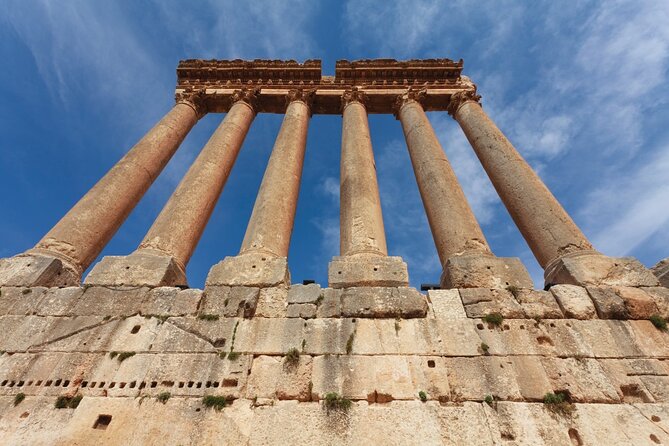
At Baalbek, you have about two hours to explore the Roman temples. The site is famous for its enormous scale and unusually well-preserved columns and structures. It is not a quick photo stop. Give yourself time to look at the engineering, the carved stone, and the way the ruins occupy such a broad open area.
Baalbek is the kind of place where a guide adds real value, particularly if you want to understand how Roman religious architecture shaped the site. Comfortable shoes are sensible because the visit involves walking across uneven archaeological ground.
The next stop is Anjar, an Umayyad settlement built as an inland commercial center. One hour allows you to see the walls, palace remains, mosque, thermal baths, and rows of pillars. Roman-style elements appear in the architecture, but the site belongs to a later period, giving the day a useful historical contrast.
Then comes Chateau Ksara, one of Lebanon’s best-known wineries. The visit includes wine tasting, a look at the cellars, and an introduction to wine production, with views over the Bekaa Valley vineyards.
This is one of the package’s best-balanced days. Baalbek supplies the grand spectacle, Anjar adds an important early Islamic site, and Ksara brings in a modern Lebanese tradition. The only drawback is that each stop is fairly brief. If wine is a major reason for your trip, one hour may leave you wanting more time at the winery.
Jeita Grotto, Harissa, and Old Byblos
Day three moves north along the coast and into the hills.
At Jeita Grotto, you visit two connected limestone cave systems formed over millions of years. The upper and lower caves offer different views of the formations, and the lower cave includes a boat ride on an underground lake.
The full visit lasts about two hours. This is a strong choice for anyone who wants a break from ruins and churches. The cave setting also makes this stop different from nearly everything else on the route. Since cave conditions can be cool and surfaces may be uneven, practical footwear and a light layer are useful.
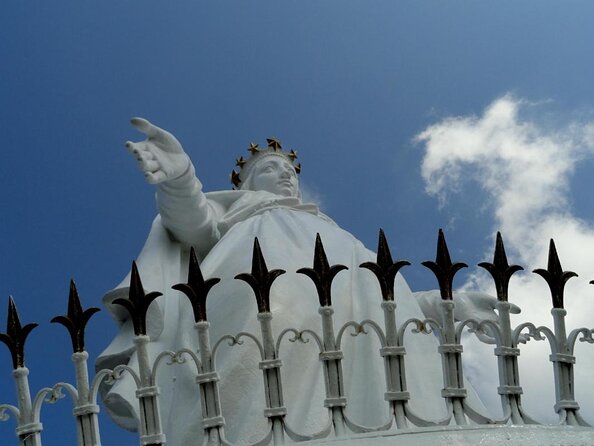
At Harissa, you visit the Shrine of Our Lady of Lebanon and climb the round stairs toward the statue. The shrine overlooks Jounieh Bay, and the cable car ride from Harissa toward Jounieh adds a memorable view from above.
The listed visit lasts about an hour, so expect a focused stop rather than an extended religious or architectural study. The cable car is a key part of the experience, but anyone uneasy with heights should keep that in mind.
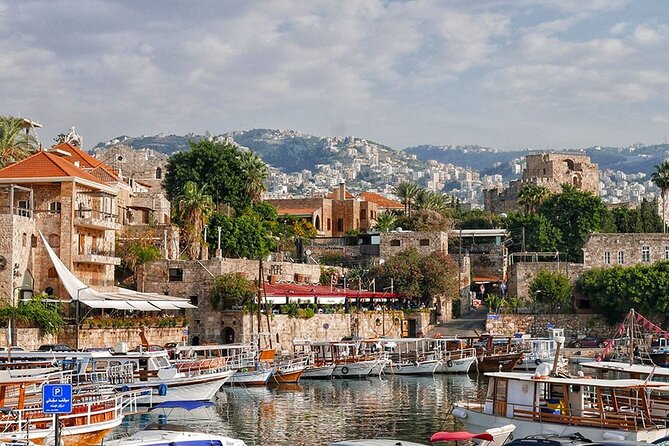
Byblos receives about two hours, followed by a separate hour at Byblos Citadel. The ancient Phoenician city is one of Lebanon’s essential stops, with archaeological remains, a Crusader castle, an old souk, and a harbor.
The citadel dates from the 12th century and sits beside ruins that include the Temple of Baalat Gebal and the Temple of the Obelisks. From the top of the square keep, you can look across the excavated remains toward the sea. A small museum and information panels add context inside.
The old souk is a short stop in the schedule, but it is worth slowing down if time allows. You can browse souvenirs and antiques, walk the cobbled lanes, and continue toward the ancient port. The port visit is also brief, so your best photographs may come during your walk between the archaeological site and the waterfront.
Byblos is a day where the schedule can feel slightly divided. Jeita Grotto and Harissa each deserve attention, while Byblos has enough archaeology and old streets for a full half-day. Still, the combination gives you a strong first look at Lebanon’s coast and Christian, Phoenician, Roman, and Crusader layers.
A completely different kind of day out:
- Jeita Grotto,Harissa&Byblos Full-Day PRIVATE-CAR Trip from Beirut
★ 5.0 · 222 reviews - First Paragliding Club in Lebanon – Since 1992
★ 5.0 · 193 reviews - Anjar, Baalbek & Ksara Day Trip – With Lunch (4G on Board)
★ 4.5 · 181 reviews - Jeita Grotto – Harissa – Byblos Trip
★ 5.0 · 169 reviews
Qadisha Valley, Bcharre, and the Cedars of God
The northern mountain day is quieter and more reflective than the coastal routes.
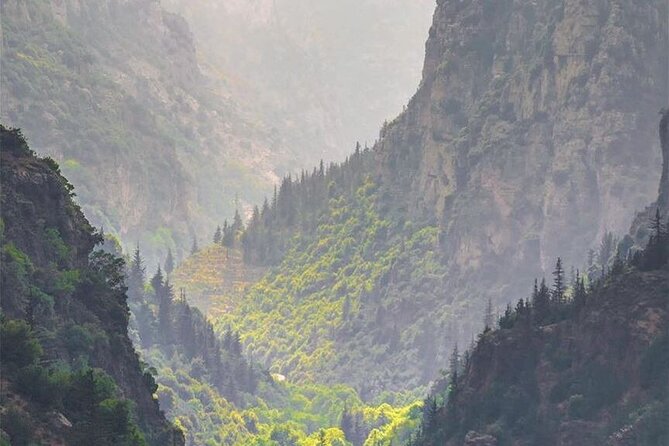
Qadisha Valley is associated with some of the earliest Christian monastic settlements. Caves, monasteries, and cultivated terraces occupy a rugged mountain setting, and the area reflects centuries of hermit life and religious retreat.
The itinerary includes Bcharre’s Kahlil Gibran Museum, housed in the former Monastery of Mar Sarkis. The museum contains original paintings and drawings, personal belongings, manuscripts, studio furniture, and the writer’s tomb. The scheduled visit is 30 minutes, so you will get an introduction rather than a long examination of his work.
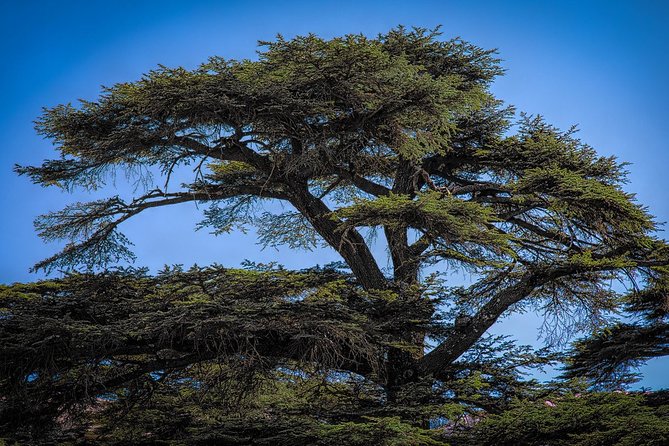
You then visit the Cedars of God, a small surviving forest of 375 trees. Cedar wood was prized in antiquity and is closely tied to Lebanon’s national identity. The cedar appears on the Lebanese flag, and the grove offers a direct connection to a symbol you will see throughout the country.
Deir Qozhaya adds another monastic stop. The Monastery of Saint Anthony the Great sits at about 950 meters in the Qozhaya Valley, surrounded by pine and oak-covered hills. Its origins are linked to hermits from the fourth century, with surviving remains dating back as far as the seventh century.
This day will suit you if you care about nature, mountain scenery, literature, and religious heritage. It may be less satisfying if you want long hikes, since no extended walking excursion is specified. The route is best understood as a series of carefully chosen viewpoints and cultural stops rather than an active trekking day.
Sidon’s Sea Castle, Soap Workshop, and Ottoman Rooms
Day five heads south and packs several different periods into one route.
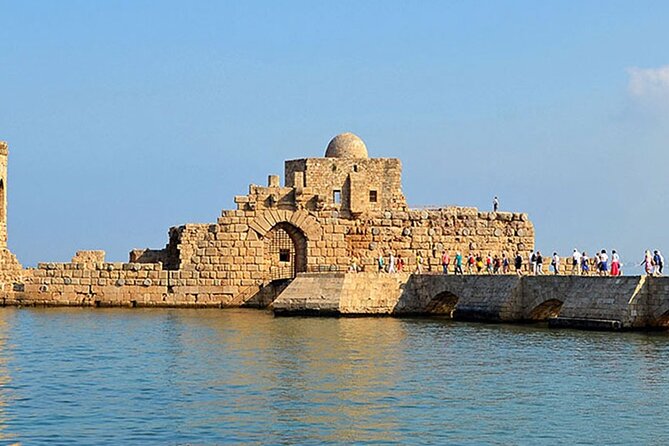
In Sidon, you begin with the Crusaders Sea Castle, built in the 13th century on a small island connected to shore by a causeway. Much of the fortress was destroyed and later restored, so the appeal lies partly in its position over the water and partly in the layers of military history visible in the remaining walls.
The old city brings a different experience. Khan al-Franj is a 17th-century inn and commercial center built around a rectangular courtyard and fountain. It once served ambassadors and merchants and later became a place connected with culture, religion, and diplomacy.
The Soap Museum is one of the more distinctive stops on the whole trip. It occupies a former soap factory dating from the 17th century, with some parts thought to be older. You learn about traditional olive oil soap, see how it was made, and find displays related to bathhouse customs and archaeological objects found on site.
Debbane Palace provides another close look at old Sidon. Built in the 18th century, it contains reception rooms, stained glass, mosaic tiles, and old stables. It is reached through a narrow stairway in the souk and is built above the market streets, which makes the visit feel connected to the city rather than separated from it.
The schedule allows about two hours for Sidon overall, with short visits to individual attractions. That is enough to sample the city, but not enough for a slow wander through every market lane. I would keep your expectations realistic and enjoy the changing scenes rather than trying to inspect every room.
At Maghdouche, Our Lady of Mantara is linked to the tradition that Mary waited in a natural cave while Jesus preached in Sidon. The stop is brief, but it adds a local religious tradition to the day.
Tyre’s Hippodrome and Ancient Necropolis
The southern route continues to Tyre, a Phoenician port associated with maritime trade and the famous purple dye made from murex sea snails.
Tyre’s story reaches from ancient Phoenician rule through Egyptian, Assyrian, Greek, Roman, Byzantine, Arab, Crusader, Mamluk, and Ottoman periods. You see that long sequence most clearly at the archaeological sites, not just in the modern town.
The Tyre Hippodrome dates to the second century AD and is described as one of the largest and best-preserved Roman examples of its type. An hour here gives you time to understand the scale of the track and imagine the public spectacles once held there.
The necropolis contains stone and marble sarcophagi from the Roman and Byzantine periods. Some carry Greek inscriptions, names, occupations, frescoes, or scenes connected to Homeric stories. This stop is especially useful if you enjoy archaeology with human details, since the inscriptions and burial objects bring individual lives into view.
Tyre also has a seaside setting and beaches, but the day is centered on heritage. With two hours for Tyre, one hour for the hippodrome, and another for the necropolis, the schedule is full. If you want a relaxed beach visit, this package does not appear designed around that.
Beirut, Beiteddine Palace, and Deir el Qamar
Day six begins with Beirut sightseeing. The city portion includes historic squares, religious sites, Roman baths, the National Museum, Zaitunay Bay, Al Manara Corniche, and the Raouche rocks.
Three hours is enough for an overview, but not a detailed museum visit plus extended time at every waterfront stop. The value here is orientation. You see how Beirut’s ancient remains, religious buildings, modern marina, seaside road, and famous rock formations fit together.
The route then climbs toward Beiteddine Palace, a 19th-century residence known for its interior architecture, courtyards, and fountain. About 90 minutes gives you a proper look without turning the visit into an all-day palace study.
Deir el Qamar follows, with red-roofed buildings, Fakhreddine Mosque, and the shrine of Our Lady of the Hill. The village offers a more relaxed final sightseeing stop, and the return toward Beirut includes mountain views.
This is a pleasant final touring day because it mixes city, palace, and village life. You are not spending another full day among ruins, and the changing scenery helps keep the program from feeling repetitive.
Your Free Day in Beirut
Day seven is intentionally open. You can shop for gifts and souvenirs, walk near the hotel, spend time in a park, stroll along the seaside road, or simply rest.
Do not underestimate the value of this pause. The earlier days include long drives and many scheduled stops, so a free day lets you recover and enjoy Beirut at your own speed. Since no specific activities are included, you should treat this as personal time rather than an additional guided excursion.
It also gives you a chance to buy Lebanese wine, soap, antiques, or other souvenirs after seeing where many of these traditions fit into the country’s culture. Personal expenses are not included, so budget separately for shopping, meals not covered, and other purchases.
Who Will Get the Most From This Package?
I would recommend this trip to you if you want a broad first visit and prefer having transport and admissions arranged. It suits people who want ancient sites, religious landmarks, natural formations, mountain towns, and city views in one trip.
It is also a good fit if you dislike changing hotels. Seven nights in Beirut keeps the logistics simple and gives you one familiar base.
You may want a different style of trip if you prefer independent travel, long lunches, extended museum visits, or several days in one town. The itinerary covers a great deal, but the short stop times mean you will often sample a place rather than settle into it.
The package is also not ideal for someone seeking a beach holiday. Tyre has attractive beaches, but the main focus is archaeology and cultural sightseeing.
The single published rating is five out of five, and the accompanying account praises the organization of excursions across Lebanon, including sites such as Tyre, Sidon, Jeita, the cedar forest, Bcharre, Faqra, Baalbek, and Byblos. The current program specifically includes many of those major destinations, though Faqra and Tripoli are not listed in the eight-day schedule, so do not assume they are part of this package.
Booking Advice and Final Verdict
Book this Lebanon package if you want the country’s major sights in a single, organized week and value a central hotel, airport help, included admissions, and an English-speaking driver. The strongest days are Baalbek with Anjar and Ksara, the Byblos and Jeita route, and the northern mountain visit to Qadisha and the cedars.
Before paying, confirm the hotel category, room arrangements, and the exact treatment of breakfast and lunch. Both are marked optional, and that detail affects the real cost.
Also look closely at the day-by-day timing. The program is rewarding because it is broad, not because it is leisurely. If you can accept early starts, road time, and short visits, the $985 price offers a practical way to see a remarkable amount of Lebanon without moving hotels every night.
The cancellation terms allow a full refund if you cancel at least three full days before the experience begins. Changes or cancellations inside that window are not accepted or refunded.
FAQ
How long is the Lebanon travel package?
The package lasts approximately eight days and includes seven nights of hotel accommodation in Beirut.
Where does the experience begin?
It begins at Beirut-Rafic Hariri International Airport, where a representative meets you in the lounge and transfers you to your Beirut hotel.
Are airport transfers included?
Yes. Round-trip airport transfers are included, using a private air-conditioned vehicle. On departure, the driver arrives at your hotel two or three hours before your flight.
Is accommodation included?
Yes. The package includes seven nights in a hotel in Beirut city.
Which major sites are included?
The scheduled visits include Baalbek, Anjar, Chateau Ksara, Jeita Grotto, Harissa, Byblos, Qadisha Valley, Bcharre, the Cedars of God, Deir Qozhaya, Sidon, Maghdouche, Tyre, Beirut, Beiteddine Palace, and Deir el Qamar.
Are entrance fees included?
Yes. All listed entrance fees are included, including the paid visits to Baalbek, Anjar, Chateau Ksara, Jeita Grotto, Harissa, Byblos Citadel, the Cedars of God, Sidon Sea Castle, the Soap Museum, Debbane Palace, Tyre Hippodrome, Tyre’s necropolis, and Beiteddine Palace.
Are meals included?
Wine tasting is included. Breakfast and lunch are listed as optional, so confirm your selected package details before booking.
How large is the group?
The organized tour activity has a maximum of 15 people. The airport transfers are private.
Can I participate if I am not an experienced hiker?
The package does not require an advanced hiking background. Most people can participate, but you should expect walking at archaeological sites, old streets, caves, palace grounds, and mountain locations.
Can I cancel for a full refund?
Yes, if you cancel at least three full days before the experience start time. Cancellations or changes made less than three full days in advance are not accepted or refunded.
Just added in Beirut
- Wine Tasting Tour★ 5.0 · 2 reviews
- Lebanon tours vip jeitta byblos beirut we charge per vechile not per person.★ 5.0 · 1 review
- Lebanon’s Treasures: Jeita Grotto and Harissa Private Tour★ 5.0 · 2 reviews
- Small Group Tour to Baalbek, Anjar & Ksara with Hotel pickup★ 5.0 · 2 reviews
- Journey Through Time: A Private Tour of Tripoli and Byblos★ 5.0 · 1 review
- Guided Small-Group Tour to Baalbek, Cedars & Qozhaya with Lunch★ 5.0 · 2 reviews
- Small-Group Tour with Lunch to Sidon, Tyre & Maghdouche★ 5.0 · 2 reviews
- Small-Group Tour Qadisha Valley, Becharre and Cedars with Lunch and Tickets★ 5.0 · 1 review